Showing posts with label Kobo Prize. Show all posts

Sunday, 28 February 2016

Book and egg giveaway

What is it about egg-shaped chocolate that makes it taste so much better?

To celebrate the arrival of Easter eggs in the shops (one of my favourite times of year), I'm running a giveaway on my author Facebook page.

All you have to do is comment on the post with the name of a friend, and you could both win this pack. Giveaway closes 4 March.

Sunday, 14 February 2016

Ms Blair recommends: The Bold Ship Phenomenal by Sarah Johnson

A nice review of my book by New Zealand book girl (Chrissi Blair) on her blog.


I've had a great time this morning trawling through the reviews on her site (I'm supposed to be working, but it's Valentine's Day). Lots of in-depth information there on kids' and young adults' books. My reading list has grown!

Here's the link... Thanks Ms Blair.

Ms Blair recommends: The Bold Ship Phenomenal by Sarah Johnson [Junior ...: The Bold Ship Phenomenal By Sarah Johnson Illustrations by Deborah Hinde Flat Bed Press, 2015 ISBN 9780473313142

Wednesday, 30 December 2015

Happy end of 2015


I think it's as important to celebrate the year that's just past (or if it hasn't been happy, to at least acknowledge it), as it is to look forward to the new one.

2015 has been fun (and hard work) for me, launching a fledgling publishing company - Flat Bed Press - and a new children's novel - The Bold Ship Phenomenal.

I also always enjoy the turn of the year, as a chance to look forward with anticipation to the next one and to plan. I love to consider and get excited about the writing projects I have scheduled.

2016 for me will be another novel in the junior fiction series I am working on at the moment. It will also, hopefully, be a polished draft of the novel for adults I have been working on seemingly for ever. There's also a picture book in the publishing pipeline.

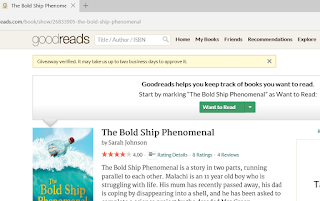
To celebrate both end and beginning, I'm running a book giveaway on Goodreads for the first two weeks of the year. All you have to do to enter is click the button (on the Goodreads site). Then wait and see...a bit like waiting to see what the New Year will actually bring.

https://www.goodreads.com/giveaway/show/167820-the-bold-ship-phenomenal


I hope yours has its fair share of adventure and joy!

Tuesday, 8 December 2015

Bold Ship Phenomenal listed as best Christmas buy

I'm chuffed that my book, The Bold Ship Phenomenal, was listed by The New Zealand Herald's Canvas magazine as one of the best books to buy for young readers this Christmas.


I'm doubly chuffed to be sandwiched between JK Rowling and the Thunderbirds. Hopefully some of their success will rub off. Bold Ships are go...

Enjoy a good scare? Author Sue Copsey tells us about her latest spooky story for kids...

I have just finished reading Sue Copsey's fabulous ghost story for kids - The Ghosts of Tarawera (Treehouse Books, 2015).

The Ghosts of Tarawera is book two in a planned series of New Zealand-based ghost stories for junior fiction and young adult readers (the first was The Ghost of Young Nick's Head (Pear Jam books, 2011)).

It's a wonderful, wonderful story, and a gripping read, which builds on and adds to the well-known ghostly appearances that preceded the Mount Tarawera eruption of 1886.

I've written a review of the book, which you can read on Goodreads (along with numerous four and five star reviews by other appreciative readers).

Sue kindly agreed to answer some questions about how she came to write the book, and what she has planned next - here's what she said. For more information, check out her website: www.suecopsey.com


Interview with Sue

The Ghosts of Tarawera draws on the famous New Zealand legend about the ghostly waka that appeared before the Mount Tarawera eruption. What was it that drew you to this story? 

I well remember the first time I read about this legend. I was editing a school textbook about the Taupo Volcanic Zone, and in amongst all this serious science there it was, as reported at the time (1886) by many tourists as well as local Maori. I was drawn to the story because there were so many witnesses:  two groups of Europeans in sightseeing boats, as well as villagers on the lake shore. The sightseers reported seeing an impressive war canoe – nothing spooky about it – but the Maori realised it was supernatural as there hadn’t been a waka of that type in the area in living memory. Local Maori also recognised it as an omen of disaster, and 11 days later were proved right when Mt Tarawera erupted. I reckon Lake Tarawera’s phantom waka, which legend says will reappear if the mountain reawakens, is far more credible than the Loch Ness monster, and look which is more famous. That’s just wrong!

Your story is very evocative of the landscapes around Lake Rotomahana and Rotorua. Did you spend much time there while you were writing the book?

I’ve been to this part of the North Island many times, so I had a good feel for it. I love the mix of forest, lakes, hills, Maori culture and weird and wonderful volcanic features. You can feel you’ve slipped back in time, to when dinosaurs roamed the Earth.

But also, Google Earth was my friend. While I was writing the book I had it almost permanently open as I zoomed in and out of satellite images looking for how the children would get across and around Lake Rotomahana before and during the eruption. When I’d finished, I hauled the family down to a bach near Mt Tarawera, and revisited the Buried Village, went on a boat trip on Lake Rotomahana, and kayaked on Lake Tarawera, making sure it all felt right, especially the atmosphere – I wanted the reader to feel they were really there, and recognise it if they visited.

What was the hardest part of the story to write, and why?

Writing the story was easy, it more or less wrote itself! But I was worried about getting the science right. I love popular science but wasn’t very good at it at school. Show me a physics equation and I feel a bit faint. I wanted to include lots of interesting facts about volcanoes and Mt Tarawera (I call it ‘education by stealth’), and to be absolutely sure I got it right, I asked GNS Science, who monitor NZ’s volcanoes and earthquakes, to check the manuscript for me. And so began the best correspondence I’ve ever had with an expert. Cornel de Ronde, who led the team that explored the lake floor at Rotomahana, contacted me, saying he loved how I was weaving all this geology into my adventure story, as he’s passionate about science education in schools. He was quite accepting of a few, ahem, liberties I took with the geology of the area in order to keep Joe, Eddie, Anastasia and Beckie alive. ‘They’d certainly die in an eruption such as you describe,’ he said. ‘But this is a moot point – it is a story, after all.’

What spooky tales did you enjoy as a child?

I liked the ‘true’ ones. Every village in Britain, where I grew up, had its spooks, and I had a book that listed just about every haunted house in the country. Thinking back, I must have been a weird child to have on holiday. Wherever we travelled in England, my twin loves of Enid Blyton’s Famous Five, and local folklore meant that I was always searching for secret passages and ghosts.

Have you ever seen a ghost?

Honestly, I don’t know – but something odd happened that makes me strongly suspect I have. It was my wedding night (seriously – no chortling please) and Michael and I were staying in a turret room in a Victorian hotel near my home town of Rugby. I was in bed and Michael was in the bathroom. In one wall was a small door which, without warning, flew open. A figure was silhouetted in the doorway, bright light behind. Then it slammed shut again. A bit like those sightseers with the phantom waka, I didn’t think this was anything supernatural, I just assumed someone had got lost in the hotel’s maze of corridors and ended up at our room by mistake. When Michael reappeared, I told him what had happened and asked him to move a table in front of the door. He did so, looking at me oddly – he thought I’d probably been half asleep (and yes, a few glasses of champagne had been imbibed).

Next morning we opened this little door to see a fire escape leading out onto the turret roof. So how could anyone have been out there, and why had there been a bright light behind them? Could this have been something spooky?

Feeling a bit silly, I asked the receptionist if the hotel had any ghostly residents, only to learn that there were several (most usually a coach and horses, a headless man, and a hand), and that people were constantly reporting strange occurences. Seems the hotel was, and still is, notorious for its ghosts – and we had no idea before that night.

This is your second novel about New Zealand ghosts. Is there another one on the horizon? And if so, can you give us a hint about the ghosts involved?

Yes indeed! Peeping over the horizon is The Ghosts of Moonlight Creek. I wanted to set my next ghost story in one of New Zealand’s old goldmining settlements, and discovered the wonderfully named Moonlight, near Queenstown. Anastasia’s movie director father is filming a fantasy movie down there and invites Joe, Eddie, Beckie and Anastasia to the movie set as a treat after their scare at Mt Tarawera. However, they soon discover filming is being held up by unexplained incidents, and the crew are beginning to call it a cursed film. I’m about a quarter of the way through and can’t wait to find out what happens!

Tuesday, 22 September 2015

Room 8 is GREAT!

Look at this wonderful blog post by the kids in Room 8 at Pukete School. Thanks guys, I had such a nice time...


Room 8 is GREAT!: Author Visit! As a part of our Inquiry into books, ...: Author Visit! As a part of our Inquiry into books, we had a visit from a New Zealand author Sarah Johnson. We read her story Wooden Arm...


Here's the picture collage they sent me afterwards. So cool!
 

Wednesday, 26 August 2015


Tui Allen has loaded this review about my book on Goodreads. Tui is an author in her own right, and our local New Zealand Society of Authors delegate, so it means a lot to me that she liked it so much. Thanks Tui.

Rollicking but Meaningful Kiwi Novel for Kids

This is a rollicking good yarn on one level but so much more than that. It has something important to say to its audience, beyond the adventure itself.
I found it un-put-down-able and read until almost midnight to finish. I'm an adult, so not even part of the target audience.
The beginning was irresistibly captivating. The romance of a ship in a bottle especially one found as flotsam (or was it jetsam perhaps? Had some power SENT that bottle to Malachi?) I was encouraged to wonder about that by the author's intriguing decision to simply reverse the usual order of those two words. Jetsam and flotsam.
The story is about Malachi and his dad who are grieving the loss of Malachi's mother. Neither are functioning to their full capacity and neither were over it yet, but Malachi reaches out for adventure and new beginnings with the help and guidance of the action that takes place among the crew of the pirate ship playing out their own story inside the bottle.
It's a story with a message of conservation. Malachi's own voyage as a stowaway on a land-based "pirate ship" takes him into a world where the prisoners he rescues are precious NZ wildlife doomed otherwise to be stolen and sold.
The story ends with powerful glimmers of hope for the future for Malachi and his dad. I love a story that shows growth in the characters as this one does. With its strong links to the sea, and its theme of the wildlife of New Zealand this is a true Kiwi story. Where else in the world do kids get to wander along an empty ocean beach on their way to school in the morning?
The book is a beautiful product. Very child-proof. I tested it. The cover design is fresh and inspiring and there is an added bonus of charming greyscale chapter-head motif drawings.
All NZ school libraries should buy multiple copies at once and it should sell internationally to give the world a glimpse of NZ.

Friday, 21 August 2015

A launch, a festival and a trio of reviews

What a week!
On Saturday I launched my latest children's book (twice) at the Word Café writers and readers festival: once for adults and once for children. Both events were wonderful.

Here's the cake that my lovely friend Zoe made for the celebrations.

 
And here's my equally lovely friend Dawn MacMillan entertaining the kids like the true professional she is.


And here's me looking very pleased with myself.
 
 
Since then my book has had three great reviews online.

"I really recommend this book because it had a lot of describing words that made me get a picture in my mind of what was happening. I like the adventure throughout the book, it made me really exited for what happened next. I would recommend it to people who have a liking for adventure."
  
Thanks Kaia. I'm so pleased that my very first review came all the way from Sweden. The Bold Ship has already travelled a long way!

Sunday, 12 July 2015

They're here...


Advance copies of my new book, The Bold Ship Phenomenal.
Are those pirates' footsteps I see beyond them?
The rest of the shipment arrives at the end of this month. Watch this space!

Wednesday, 24 June 2015

Conversations in self-publishing for the serially challenged 5: crunching the numbers


The Bold Ship Phenomenal is safely out of my hands – in China being printed – so I thought I would look at the thorny question of costs.
When I decided to publish the story myself, one of my publishing ‘values’, as it were, was that the book had to be a top-class production. This was important to me, not only because I trained in publishing, but because this was my product: I had to stand by it for as long as it endured in the world, and I wanted to be proud of it.

I’ve done my best, and with the help of all the talented professionals who’ve played their part in getting the book to this stage, I think we’ve got a great result. But of course all this help costs, and what became clear very early on (in fact, before I even started, when I did my first rough budget) is that I was unlikely to ever make any money on it. Luckily that was never one of my aims.

I’ve listed the costs I’ve incurred below, so that anyone setting out on this route can see the type of expenses involved, and where they might be able to save on costs by finding a cheaper option or doing it themselves (something I haven’t been very good at).
The figures given are rough – both to protect my suppliers’ modesty, and to reflect the range of prices I was quoted for particular tasks (which on occasion, varied widely).

This list is not the end of the expenses, there is still warehousing, and promotion, and GST and other taxes, and bad debtors (assuming I make any sales) to contend with. But these are the bulk of the up-front costs, and I hope you’ll find them useful. Figures exclude GST.
·        Editing – $600

·        Proofreading – $250

·        Illustration – $1200

·        Design – $2000

·        Printing – $4000

·        Freight – $500 (very roughly, as this part of the process is still to come)         

→Total so far = $9400, which for 1500 books, means that $6.26 per book is production costs.
For a $20 book, where the bookseller takes 40% ($8), and the distributor 25% ($5), and the GST accounts for 15% ($3), you can see the quandary.

Except that it’s not a quandary, if you want to see your book in print. And looking purely at the dollar side of things overlooks the non-monetary gains, one of which has undoubtedly been the enormous help and support I have received from all the book professionals involved: worth every cent!     

Friday, 5 June 2015

It’s a first – twice

I’ve had two pleasant surprises and two firsts in one week.

First (of the firsts) is this online listing for The Bold Ship Phenomenal on Nationwide Book Distributors website.  They’re distributing the book for me, and they’re taking trade pre-orders now.

 
The second first is The Bold Ship Phenomenal’s first review. This is what Sue Copsey says about it on her blog.

“…The Bold Ship Phenomenal, due out later this year, made me cry as I edited it. It’s not a sad book though – the make-you-cry bit is just a small part. The rest is a page-turning adventure with a ship in a bottle as its star, and a strong nature theme. It’s classically New Zealand, but everyone, everywhere will love it. Take my word for it!”

 
Thanks Sue, although I hope there wasn’t too much crying going on (it’s not meant to be sad – well just a smidgen).

So what with two surprises and confirmation that printing is underway in China, it’s been a pretty exciting week all round. The Bold Ship Phenomenal, as a book, rather than a story, is beginning to feel real.

Sunday, 19 April 2015

Conversations about self-publishing for the serially challenged 4: dotting your i’s


Looking at the title I chose for this series of blogs, I’m beginning to feel rather less serially challenged than when I began. I realise I’ve learnt a huge amount, along the way. That can only be a good thing if self-, or indie-, or hybrid-publishing is to become more the norm for New Zealand authors. I now have a much better idea of what is involved, and to be honest, it’s very exciting.
In past posts I have talked about it surprised me how creative the editing side of things is. Now as I move more into the actual publishing process what surprises me is how much fun it is. I’m having a blast. I guess that’s not surprising, given I love books (of course I’d enjoy making one of my own), but still it is not what I expected. Lots of work – yes – but very enjoyable too.

A friend who is herself considering self-publishing asked me recently what exactly I have been doing. I sent her the email below, in the hope it would help her process when she reached that stage. I hope it helps yours too.

What you'll need to do:
1.      Finish writing your book.

2.      Get it professionally edited – this step is kind-of optional, if you’re also an editor, but not really if you want a good product. It’s extremely hard to objectively edit your own work.

3.      Get it proofread ­– also only kind-of optional. The last thing you want is errors.

4.      Find and brief a book designer ­– there are plenty. Find one whose covers and internal designs you like, and who produces the type of books (in terms of format) that you’re after.

5.      Find and brief an illustrator – if you are using one. I have been lucky to have a friend whose work I know is wonderful. She’s doing my cover and internal illustrations. Otherwise, you may need to find a cover image you want to use (unless your designer does this for you).

6.      Decide on a publishing name and logo (if you are using one). Also, whether or not you are going to form a company. My accountant has advised the latter may be a good idea if I plan to publish more books, especially by other authors. Something to think about for the future.  

7.      Get an ISBN number, or several if you’re printing in different formats; from the National Library website. A very straightforward process, but you may need to query them if they tell you (as they did me) that you can’t have it until four weeks before the book is printed. Obviously this doesn’t work if you are printing overseas.

8.      Get a barcode – you can do this online. It’s based on your ISBN and costs around $30. I used Barcodes Limited (www.barcodes.co.nz).   

9.      Get quotes from a printer – I got a few, but you could get lots of quotes. There’s a big difference between them. I think I’m going to get the book printed in China, but actually some of the New Zealand quotes I got were getting close, in terms of costs.

10.   Organise a freight agent – if you’re printing overseas, this seems to be cheaper than letting the printers organise the freight, and there should be no hidden costs (fingers crossed). They should itemise all the subsidiary costs you’ll encounter when importing books.

11.   Find a distributor – there are several, but I have found them hard to raise a response from. I am unsure if this is because they are swamped with submissions from self-published authors or, conversely, are not yet used to dealing with them. You may have more luck if you have the designed product to show them. If you do get a response, they will send you their terms of trade, including how much commission they take and where they will try to place your book.

12.   Pay everyone, including the GST on the imported books. Kat says she got stung for this.

13.   Move onto the next big step: receiving, promoting and selling your book.

Whew! No wonder I’ve felt busy. But like I said, all good fun.  


Tuesday, 3 February 2015

The professional edit: Conversations about self-publishing for the serially challenged 3


I am two-thirds of the way through having the manuscript for my hopefully soon to be self-published book, The Bold Ship Phenomenal, edited, and what continues to amaze me is the extent of the changes that I, and now the editor, am making even at this late stage.


I work, in my day job, as a professional writer, so rewriting and rehashing and reimagining are no stranger to me. I actually enjoy them, and have no doubts that they strengthen a piece of writing.

It is the nature and size of these late changes that surprises. The Bold Ship Phenomenal has been through more structural and fine edits than I care to remember. It has been – rewritten, rehashed and reimagined. Yet I find I am revising whole scenes, adding new ones, strengthening connections, embellishing and excising details.

The process feels like tightening a belt, or a net, around the essence of the story, until its clarity is secured.   

I guess what I had not appreciated is how creative the external editing process would be, and in this respect, I feel I have struck it lucky with the editor I have chosen, Sue Copsey.

This no credit to me (all credit to Sue). Sue was a senior editor at Dorling Kindersley in London, before coming to New Zealand and freelancing for several publishing houses here. She is an established children’s writer in her own right.

There were no shortage of good options when I was looking for an external editor (one positive side of the current publishing crunch is that there are lots of talented publishing professionals now offering their skills on a freelance basis). But it was important to me that I found someone with experience working with children’s books. Children’s writing is different. It is magic and inspiration and wonder. Done well, it is transportation and transformation. An editor needs to get that. I feel confident that Sue does.

I’m also very grateful that she’s responded positively to my manuscript (thanks Sue). In the absence of a traditional publisher acting as gatekeeper, it can be hard to remain 100 per cent positive about the calibre of your work. Yet, paradoxically, it becomes even more important to maintain that calibre when you self-publish. This is your work, and there is only you to stand by it, so quality – of story, of process, of the finished product – becomes all.


I’ve found it helps to have supportive writer friends (‘Of course you must do it’), and I’ve also found encouragement to go ahead from an unlooked-for quarter – nature.
I love to walk (like lots of writer I find it a vital part of the creative process) and on recent walks I have increasingly stumbled upon signs from nature that support my decision to publish my story myself.

Now I don’t mean to sound like a fruitcake. I don’t mean that little birds have flown down and tweeted in my ear (or that whales have smiled at me or miniature pirates waved me on). What I have noticed is things in my environment, the west coast New Zealand environment, that have said to me – yes, this is what we are like, this is worth telling, this is wondrous and amazing, uniquely our own, there is a story in this: give it your best shot Sarah, it is worth writing about.

Tuesday, 23 December 2014

Wooden Arms goes international


Check out this picture of Wooden Arms being read to a class at the Anglo American International School in Moscow.


OK, so it helps that the reader (Nick) is the husband of one of my oldest friends. As a New Zealand children's writer, it's a good idea to have friends (or relatives) with kids in exotic places.  

I wondered what the audience would make of the New Zealand context, but apparently they loved it. I guess the theme of places we have loved and left is a universal one, especially for these international students, and in a city with such glorious buildings as Moscow.

There's a podcast of Wooden Arms being read by Matu Ngaropo on Radio New Zealand's website: you can listen to or download it here The recording is part of the Storytime Treasure Chest.

Friday, 29 August 2014

The structural edit: Conversations about self-publishing for the serially challenged 2

Phew! That was a mission.

I smile to see that, when I decided that the first thing I needed to do to get my manuscript – the Bold Ship Phenomenal – ready for publication was give it a structural edit, I allowed myself two weeks to complete the task.

How long has it taken me? Three months.

This is not the first structural edit mind you. In fact, it is probably closer to the twentieth. Yet when I decided to self-publish, it still seemed essential that I do yet another. The reason, I have realised, is the greater burden – to act as both creator and gatekeeper – that rests on the self-published author.

In a traditional publishing model, you (the author) create something and the publisher says ‘yeah’ or ‘nay’. They are the gatekeeper; the arbiter of quality, freshness, appeal, and of being ‘good enough’. As self-publisher you must fulfil this role yourself. It is your work after all and you must stand by it (hopefully with pride) once it takes its place in the world.

Yet, it is a curious concept this ‘good enough’. One of the pitfalls of the traditional model is that good enough can lead to a lack of ambition and sameness in what is being publishing. Conversely, one of the wonders of the new indie publishing scene is the freedom it affords authors to produce and make publically available new and strangely beautiful and unsettling works.

Yet as any good editor will tell you, it is difficult (some would say impossible) for a writer to gain sufficient distance from their work to see what needs to be done to bring it onto its finest form.
Hence the delay. Rather than being a straightforward matter of shifting bits around, my structural edit has been an angst process of asking ‘Is this right?’, ‘Could this be better?’, ‘Will this appeal to readers in the way I intend, or is the appeal limited to me?’. In short: ‘Is this good enough?’


I have been cheered in this process by Austin Kleon, whose small books (Steal Like an Artist and Show Your Work) I stumbled upon mid-way through. Austin takes a pragmatic and enabling approach to the creative process, urging people to trust in the value of their creativity and put its products out there. (You can listen to his manifesto on stealing like an artist here.)
 
Of particular value was his insight (in Show Your Work) that “you don’t have to be a genius”.  Everyone, he argues, has something to contribute, and it is OK to “be an amateur”.

“Amateurs are not afraid to make mistakes or look ridiculous in public. They’re in love, so they don’t hesitate to do work that others think of as silly or just plain stupid,” he says (Workman Publishing, New York, p.15).

So it is with The Bold Ship Phenomenal. I do love this story. It carries part of me in it. So I must act like an amateur and be willing to put it out there and potentially look ridiculous in public, while at the same time doing everything in my power to make it ‘good enough’. I owe it – I feel – to the story and to the readers who will (again hopefully) one day share it.  

Friday, 30 May 2014

Conversations about self-publishing for the serially challenged

It was a good week last week. I sent off two stories to publishers (with fingers tied in double-bows, sheep’s shanks and half-hitches) and am now in that lovely hiatus that opens up between sending a manuscript, and finding out it is not wanted.

When I started writing this was a period of breathless hope and anticipation for the post.  Now (having received my fair share of rejections), it is more a time of quiet pleasure: at having finished a project (an achievement in itself), and for celebrating the beginning of a story’s journey into the world, which is in fact what the initial submission is.

It’s also a time of excitement, because I get to start something new. While I always have a stew of ideas and story scraps milling around my writing desk, I find I have to focus on one story at a time if I am to get them out the door (and who wants a finished story hanging around? It’s like being hounded by a dog that wants a walk). So when one’s gone, I get to start the next. Wonderful!

Next up for me is The Bold Ship Phenomenal, a story that has been making circuitous journeys off my desk and onto the desks of publishers and back again for some years now, yet refuses to either find a home or lie down and die. It was shortlisted for the Kobo/NZ Society of Authors e-publishing prize last year, but didn’t win, so back, once again, it came.

Now I have decided to self-publish it (it is winking encouragingly up at me as I write). Being rather late off (or on) the bandwagon for most things, I have never self-published anything before, and other than a vague idea, am not even particularly sure how to do it.

So for the next few months, I’m going to record this particular journey in my blog, in the hope that what I find out may help, or at least amuse, some of you. It’s self-publishing for the serially challenged because it’s for people like me whose natural environment to date has been paper, who have large families (or even small ones) to care for, who work, who love to get out into the world and wonder and play (and frequently do), and who on top of that write…and now publish.

Looking at that list, all I can say is thank goodness for publishers who sometimes say yes. But thank goodness also for having options. I can’t wait to get started. I’ll let you know how I get on.  

And the picture? It's gorgeous Ngarunui beach in Whaingaroa Raglan where I live, but it's also where my little ship begins its journey. Not this beach, in particular, but any beach where the waves roll onto the sand, then retreat like beckoning fingers, leaving  behind treasures for sharp-eyed beachcombers to find...                

Wednesday, 13 November 2013

The next step


Voting has closed for the Kobo Prize, so thank you to everyone who voted for me (and to those who didn’t, but were nice enough to read my excerpt). I’ll let you know how I get on.

Regardless of the result, I have decided I want The Bold Ship Phenomenal to see the light of day, and that if Kobo don’t do it, I will do it myself. Part of the reason is that I studied publishing at university, and have always wanted to have go at creating a beautiful book for myself. The other part is that I am very fond of the story, and would like to release it into the world. Either way, the book, or books, need to be as good and as gorgeous as they can be.

There’s a lot to think about and learn, and I’ll keep you posted as I go, in case you decide to do the same yourself (or, like me, just find it interesting).

Fortuitously, I attended an excellent workshop at the weekend with The Storybridge crew (Jocelyn Watkin and James George) on self-publishing and marketing your books online. Their tag line is “We help you to tell your own story in your own way. The Story Bridge team offers a supported pathway to new heights for storytelling and publishing”. It’s very apt and I thoroughly recommend their courses (there are more) for anyone keen to hone their skills or get support for their writing practice.

Certainly I came away from the self-publishing weekend all fired up with ideas and expectations, and armed with great tips for how to create a quality book.

Wish me luck!

Tuesday, 15 October 2013

Voting has started for the Kobo Prize


Voting has started for the Kobo NZ Authors E-Publishing Prize. My children’s novel, The Bold Ship Phenomenal, is one of the five novels shortlisted for the fiction category. Very exciting!

So please go online and vote for me. Here is the link: Kobo prize voting.

40 per cent of the judging is by reader voting, so your vote will make a difference. (Blimey, I sound like a politician.)

For anyone who wants a little taster, I've included the first chapter below. You can read a longer extract on the voting site.

Many thanks and I’ll keep you posted how I get on. 
The Bold Ship Phenomenal
Chapter one

The problem with life, thought Malachi as he trudged along the tide line, was science. It wasn’t the only problem, no way, but at this point it was certainly one of his biggest.
“Science sucks,” he said, booting at the sand, so that it rose and scattered before him in a damp fan.  “Science sucks.” Then again, louder and louder, until he was practically shouting it, “Science sucks, science sucks”. And to make matters worse, science was the first lesson of the day and he was already late. “Scien...”, he began again.
But then he saw the bottle and he stopped.
The bottle was propped, several meters below the tide mark, in a shallow pool left by the retreating sea. Further down the beach, the sea ssshh ssshhed as it slid onto the sand, but the pool that the bottle rested in was perfectly still, its blue-green surface cradling its glassy catch.
Normally this was exactly the sort of thing that interested Malachi. Stumbled upon treasures, jetsam and flotsam, he would scoop them up and squirrel them home to examine in the peace of his room. But today he couldn’t be bothered. Not with the way he was feeling, not after the way his day had kicked off.
He aimed another angry swipe at the sand and hoisted his bag up his back. He would have to hurry. But something about the bottle drew back his eye. Something about the way it reclined, as if it was struggling to stand upright, its top reflecting sunlight in smatters and sparks, like a miniature lighthouse on the shores of an inland sea.
Malachi dropped his bag and balanced on the pool’s edge to ease the bottle free. The bottle was large and surprisingly heavy. Slime-stained string coiled around its neck, below an orange wax bung. Grey barnacles clung on its belly and base, and its glass was coated in algae and a thick clouding of salt. 
Malachi stretched his sleeve over his hand and dipped his palm in the pool. He rubbed the bottle with the wet sleeve, trying to make a clear space in the glass. As he rubbed, the sound of the ocean filled his head. Gently at first – shh, shh, shh – then building, until the waves’ song thumped and thundered on the shore.
Startled, Malachi looked up, but the beach was quiet. The waves along the tide line had shrunk if anything, melting back into themselves before they finished their journey up the sand. Only the occasional sea bird, flying low, moved or called.
Malachi looked back down at the bottle but his rubbing had made no difference and the glass was still too murky to see inside. The bottle was certainly heavy though, as if it may be full, although when he shook it no liquid sloshed against the glass. He would have liked to take it home and clean it properly, see what was inside, but he was too late for that. Being late was Dad’s fault, but if he was any later Mrs Green would be back on the phone, back on his case, and that was the last thing he needed. Cleaning the bottle would just have to wait.
He took off his jersey and wrapped it carefully around the bottle, before clearing a space in the top of his pack. He placed the bottle in, did up the zip and eased the pack onto his back. Then, trying to keep as even a gait as possible, he jogged along the tide line, making up for lost time as he headed straight for school. 


Friday, 20 September 2013

Bold Ship Phenomenal shortlisted for Kobo Prize


How exciting! I have just found out that my manuscript, The Bold Ship Phenomenal, has been shortlisted for the KOBO/ NZ Authors E-Publishing Prize.

This is the first year the prize has been offered. It gives two authors the opportunity to have their unpublished manuscripts (one fiction and one non-fiction) prepared for and published in e-book format, then promoted by Kobo for sale in New Zealand.

I was actually in the process of preparing the manuscript for publication as a print and e-book (just for the fun of it, because authors can now do this) when this happened. It’s great to know that someone else thinks the story will work as an e-book. And whether I win or not, it feels like a win-win situation; now I can splash across my cover (when I have it designed) that it was shortlisted.

I’m so pleased. Writing can be a dispiriting process at times, especially when you get plenty of rejections, and publishing opportunities in New Zealand appear to be shrinking. This type of boost is exactly what writers need to keep them going.

Part of the judging process involves online reader voting, so please go online when voting opens in October, and read my excerpt. Hopefully you’ll enjoy it enough to vote for me.