Showing posts with label children's books. Show all posts

Saturday, 15 April 2017

A week of thank yous


This week I’ve visited three schools who have been taking part in #NZReadaloud and reading The Bold Ship Phenomenal: Selwyn Ridge in Welcome Bay in Tauranga, Knighton in Hamilton, and Marist in Mt Albert in Auckland.

Look at all these amazing thank you cards that the students kindly made for me. 

The jar in the middle is full of messages-in-a-jar (rather than a bottle). So cool!


It’s me who needs to be thanking the teachers for inviting me, and the kids for being so interesting and interested. I really enjoyed hearing their ideas about the story; in particular, where the ship had gone and what was sunk beneath the buoy. Some of them even offered to write the next book for me!

Here’s some close-ups of a few of the wonderful cards.


One of my favourite thank you messages was from Theo who said: “I enjoyed how the story was kind of dull then BAM! At chapter 28, PLOT TWIST.”


Chapter 28! That’s two-thirds of the way through the book! I’m so sorry Theo that you had to wait so long for it to get exciting. I promise in my next book I’ll put a plot twist much nearer to the start. 


Friday, 25 November 2016

Thank you Koromatua and Bankwood schools


This past week has been busy. On Wednesday, I attended Bankwood School's whole-of-school production of Wooden Arms. It was absolutely superb, with some very funny additions (like dancing gumboot-wearing farmers). You can see the video here.

I was really moved to hear my words being performed back to me: taking on a life of their own.

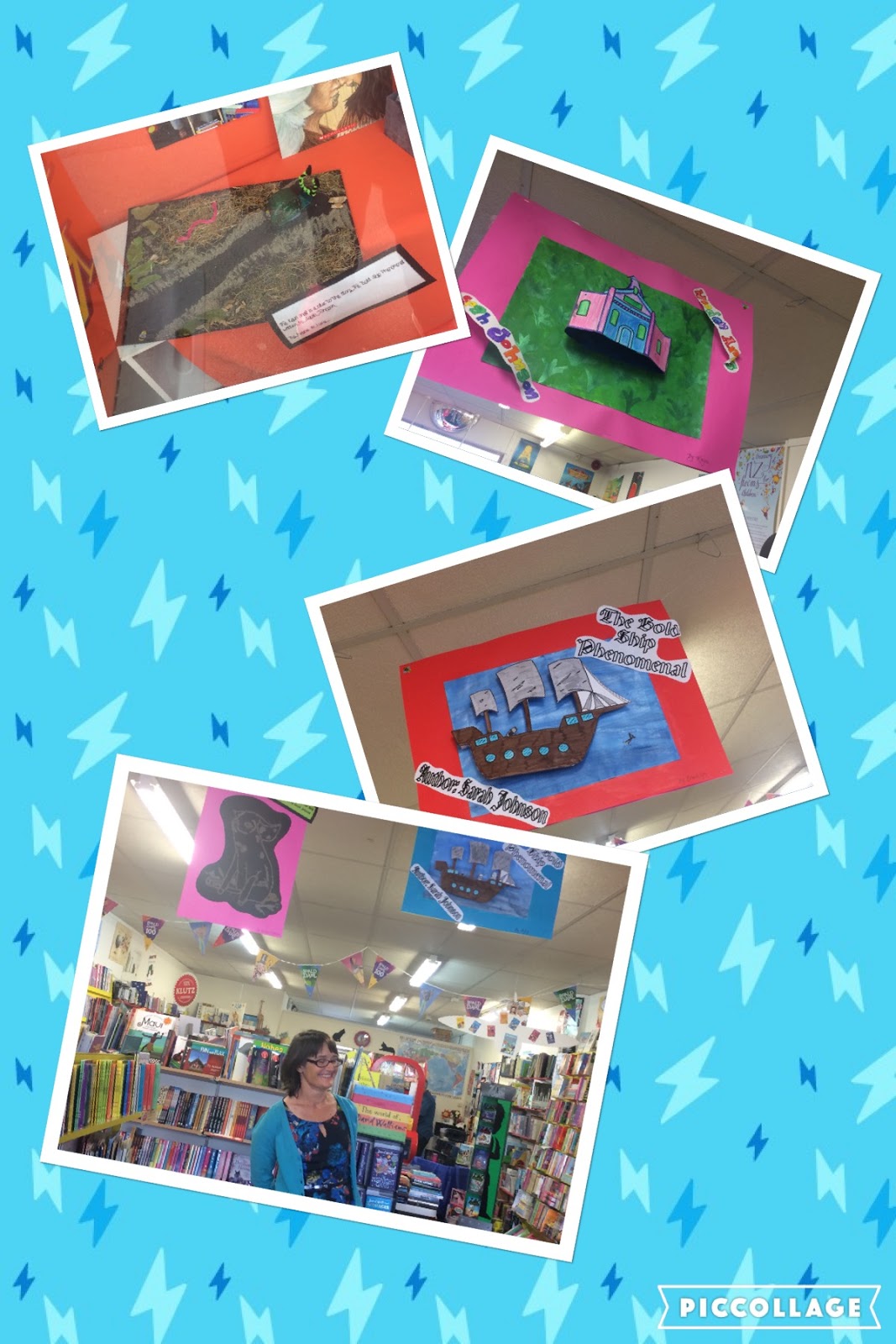
Then on Saturday, I was at Books For Kids in Hamilton East, helping Anne and Helen celebrate the bookshop's 45th birthday. Lots of the Bankwood kids came in, and they made this fabulous artwork to decorate the shop.


Sunday, I was at the Raglan creative market with Deb Hinde, selling books. Deb was selling her latest book, Hare (as well as several others), which has only been out for two weeks!


Then on Tuesday, Sherane from Koromatua School sent me these fabulous pictures of all the artwork her class has been doing since I visited last month. I love those ship-in-a-bottles! Sherane tells me they are easy to make, so I'll have go this weekend. I doubt mine will look anywhere near as good as the kids though.


Thank you Bankwood and Koromatua Schools. I have had such a fabulous time sharing writing with you this year.

Friday, 16 September 2016

Octopus in a rock pool


Recently, at the rock pools in Tairua, I had an amazing encounter. Octopi! Two of them, in the same rock pool.

That in itself is worthy of note: to find not one, but two beautiful octopi on the same day. But what happened next was even more amazing. One of the octopi, the larger one, raised its head to the surface of the rock pool and spoke…    


So here I am, an octopus in a rock pool.

It is not, to be fair, the most flash rock pool I’ve been in.

For a start, there are the shrimps: whiskery, flibberty creatures that pester an animal when he’s trying to hide. The anemones too, wink, stare.

Yet, in the absence of a larger claim to occupation, a seal say or an eel, I fancy I may call it my own.

What is that you say? You consider a rock pool not the safest place for an octopus to reside.

On the contrary! Note the abundance of nook and crevasse; perfect for containing a body soft as an over-ripe fruit. A fluid body, lithe and unencumbered by meddlesome bones.

You disagree? Claim a soft body can be disadvantage, in the presence of, say, a spear.

Oh, I see, you have one there.

Ah, yes, and here it is. You brandish it before you like a toasting fork over hot coals.  

Yes, yes, that is close enough; I assure you, I see your point.

Perhaps that is the downfall, after all, of a rock pool – no immediate means of escape.

Although containment can, itself, be offset by the proximity of the sea.

Yes, that’s right, the sea.

We are, after all, talking of a temporary inland outpost; the connection to the mother water remains.

You snigger, yet I would not expect you to understand, land lubber as you are, with your parcels and packages of tidily allotted ground. With the sea we take a broader view: connection rather than fence. Pool to sea to tributary, animal to animal, it is all as one.

Take, for example, my large friend here.

 Where? There. See there, where he rears behind you

Yes, indeed, he is an orca. Note the black and white warrior markings, the musculature of the sides.

Good idea, drop the spear, you’ll find it serves you little use now.

Now then, as I was saying…

So here I am, an octopus in a rock pool.       

Tuesday, 30 August 2016

Junior fiction finalists: New Zealand Children's Book awards 2016

A photo from the 2016 New Zealand Children's Book Awards ceremony, held at Circa Theatre in Wellington on 8 August 2016.


These are the finalists for the junior fiction category: Jane Bloomfield, me, Stacy Gregg, Kate De Goldi, and David Hill. Kate won our category with her novel, From the Cutting of Barney Kettle.


The photo reminds me what a fabulous time I (and my boys) had on the night, meeting all these New Zealand authors we admire so much. For me, that was prize enough!

Thanks to Matt Bialostocki who took the photo.

Friday, 22 July 2016

Joy and books at school visits

It's the season for school visits and I've had several fabulous ones recently, with more scheduled for next month.

The wonderful photos below were taken during my visit to Te Mata School, when I was kidnapped by this cut-throat band of pirates. The whole school had dressed up for the occasion - what a treat!


One dedicated teacher (Tanya) at Bankwood School in Hamilton created this Glogster for her class to use in preparation for my visit. By the time I got there, the kids knew more about me and my books than I did. I really appreciated that effort.


Tanya says she's happy to share the Glogster for other teachers and librarians to use. You can download it here, and when I update my website (shortly) I'll include it on the school visits page as well.

Friday, 10 June 2016

Bold Ship shortlisted for the New Zealand Children's Book Awards


I'm so excited that The Bold Ship Phenomenal has been shortlisted for the 2016 New Zealand Children's Book Awards.

There are four other shortlisted titles in the junior fiction category. I've read most of them (and will set about reading the other) and am honoured to be listed alongside them.
  • David Hill - Enemy Camp
  • Kate De Goldi - From the Cutting Room of Barney Kettle
  • Jane Bloomfield - Lily Max: Satin, Scissors, Frock
  • Stacy Gregg - The Girl Who Rode the Wind.


The awards ceremony is in August, and I'm feeling star-struck already. Many of the shortlisted authors from across all of the categories are my writing heroes.
 
Here's the awards shortlist.

And here's the judges' report.

And here are the lovely folk from Smartwork Creative who designed the book.


Three of the shortlisted books are their handy work, so they have every reason to feel pleased with themselves!


Tuesday, 31 May 2016

Stumbling upon the sources of story

I love to walk, and lots of ideas for new stories and snippets for stories I am working on come to me when I am out and about. This is not unusual. Many, many writers find that walking has this effect.

Recently I had the reverse experience.
While out walking, I stumbled across this dark thicket of tree ferns.

The track I was walking on is called the Lynch Stream track and it runs from the ridge of a hill on the East coast of the Coromandel (near Sailor’s Grave) down, down, down to Otara Bay. All the way you are crossing and re-crossing the Lynch Stream, which is great fun, then about halfway down you come to these ferns.
 
Now I have walked this track several times, but this time I pulled up short and thought ‘Ah-ha. Of course!’

You see, in my children’s novel, The Bold Ship Phenomenal, my protagonist (Malachi – the hero of the story) hides in a dark thicket just like this in Chapter 32, when he’s running away from some baddies (called the Jarrods).

Malachi leapt, dodged, scaled, sidestepped, burrowed and crashed. Vines whipped his shins and roots trapped his toes. Twice he stumbled, the second time jarring his right wrist so badly that he cried out with pain. Yet he couldn’t shake off the Jarrods, and the sound of their crashing and swearing followed him, like a bad-natured echo, through the bush.

He was almost too tired to carry on when he spotted another path. Gratefully, he took it, following its narrow passage until he reached a thick stand of ponga.

The tree ferns’ inky trunks made a pool of darker shadow within the dim undergrowth. Malachi veered off into them, heading for the gloomy heart of the stand where the shadows looked almost black. But when he reached it, he found the blackness wasn’t shadows, it was a cave.

The cave was tucked under a low hillock and had a wide shallow mouth. Dead ponga logs and fronds were piled around it. Almost, thought Malachi, as if someone had tried to disguise the entrance. He dropped to his knees and crawled inside, inching into the darkness until he was sure he couldn’t be seen from outside.
 

Although I didn’t realise it when I wrote it, this must be where my fictional stand of tree ferns came from.
I had a similar experience a couple of weeks’ later when reading one of my own childhood favourites – The Borrowers, by Mary Norton – to my son.

For those of you who don’t know the story, the Borrowers are a race of tiny people who live in the floors, walls, crooks and crannies of houses, and make their living by ‘borrowing’ from the houses’ larger occupants.

Naturally, they have to remain hidden, and the family of Borrowers that the story is about (the Clocks) have the main entrance to their under-floor home concealed under a large grandfather clock.

When I read the story to my son, I had another ‘Ah-ha’ moment.
In my other children’s novel, Ella and Ob, I also have a clock, and as soon as I re-read about the Borrower’s clock, I realised I had ‘borrowed’ it for my own story.
Here’s Jenny Cooper’s fabulous picture of my clock on the cover of the book.
And here it is being walked into (by a ghost) in Chapter One.

But this was no ordinary bump. This was the kind of bump that, if you were awake and alone in the house, would make you jump, and yell, “Who’s there?” Bella had been asleep, but this bump made her sit bolt upright in her bed, and stare around the dark room. Because this bump sounded like someone had walked into the grandmother clock.

            Bella’s father had shifted the clock from the lounge that morning, as he could no longer bear to be reminded of time passing. It now stood in the hall outside Bella’s bedroom door.

            There was another bump and this time Bella jumped right out of bed. “Who’s there?’ she whispered into the darkness.

            Silence.

            Then, bump.

            The clock’s springs pinged and its pendulums knocked softly against its wooden sides. Bella grabbed her torch and tiptoed towards her bedroom door. She eased it open.

            “Curses,” grumbled a quiet voice. “Who put that there?”

            Bella peered through the crack she had made, but all she could see was the stretched and skewed shadows that always accumulated in the hall at night. 

            “I mean to say, what a stupid place to put a clock!” the voice continued. “Now I’ve gone and messed up my feathers.”

That’s how stories work (at least for me). Little bits and pieces – from places you’ve been, things you’ve read, things you’ve heard about or thought about or seen – join together in your head until you have a spark of a story. At first it’s usually just a tiny spark, but once it’s ignited other bits join it, and it gets bigger and bigger until it’s ready to be written.               
And all this often happens while you’re out walking!    

Monday, 18 April 2016

There's a witches' cauldron on our beach


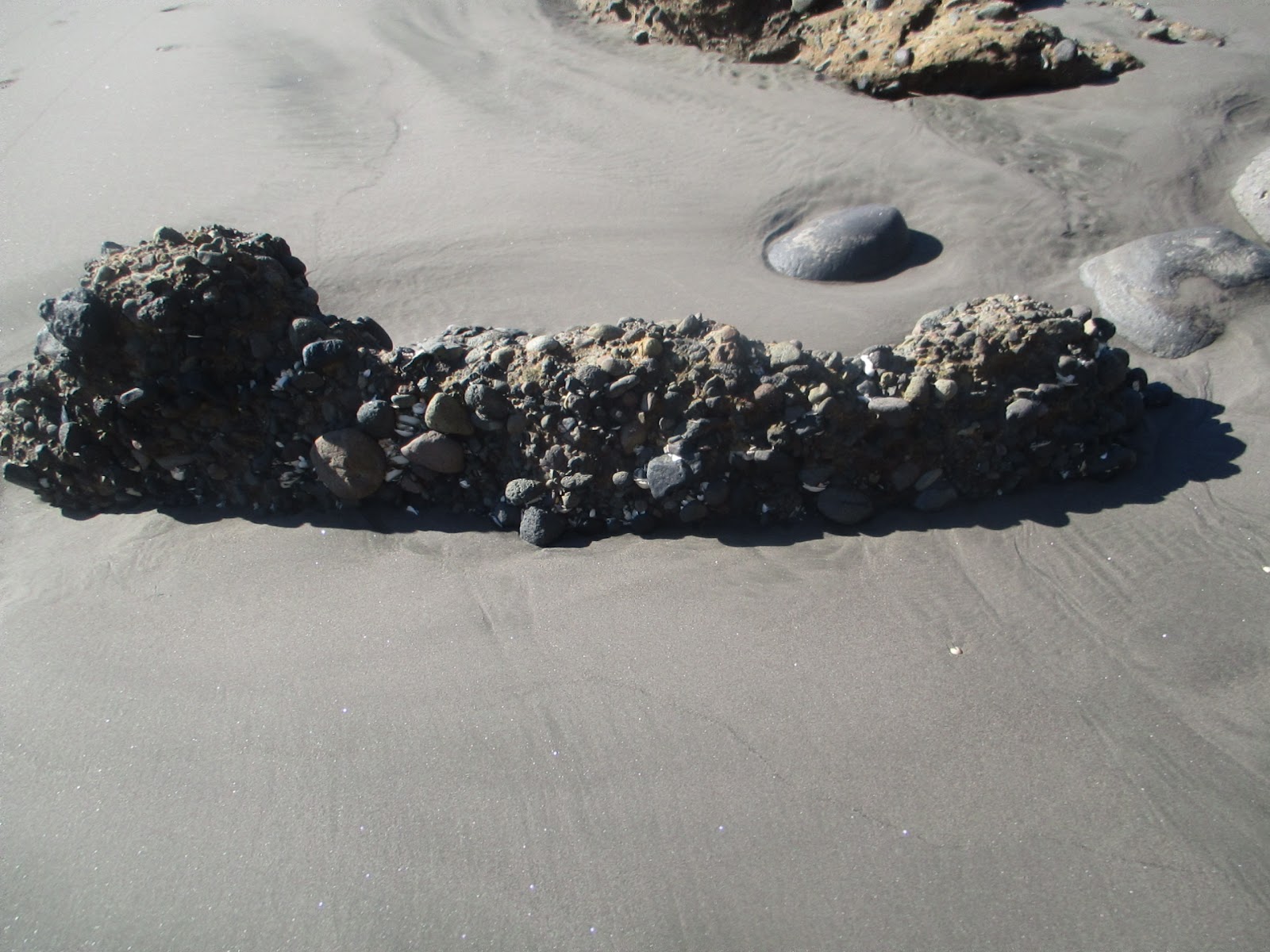
There’s a witches’ cauldron on Ngarunui Beach.

Have you seen it?

Three dinosaur eggs lie inside, smooth as stone.


Enormous nobbled creatures have populated the beach.

They wallow in their shingly sea.

Are they waiting? Will they rise?  


See the eye, the claw, the gristle spine, the grinding jaw.


The tide makes whales of the sandbanks

Grey backs breach and bask

Swimming for the hills.


Lone stone posts dot the shore

Like gnomes hats

They wig-wag in the breeze.


Footprints, imprints, tail slide, broom whisk

There’s a witches’ cauldron on Ngarunui Beach

Dare you see it?

Don’t fall in it!  

Tuesday, 12 April 2016

Wooden Arms on stage

Ben built me my own whare manaaki tangata.
 

Here it is in action at the Waikato Show last weekend, where, along with Judi Billcliff and friends, I staged my first ever production of Wooden Arms.


It was so much fun, but thank goodness that Judi, who's a drama teacher and performance poet for kids, was there to help! Check out her Rainbow Poetry website and Rainbow Poetry Facebook page to see Judi in action.

One of the good things about being an author is that it pushes you outside your comfort zone. Being on a stage is definitely outside mine!

But now that I've got my whare, Judi's going to give me some drama tips, then I'll use the Wooden Arms performance at school visits.

Saturday, 2 April 2016

Bookshelf envy

Last year I had shed envy (for Dawn McMillan’s writing hut overlooking the Thames coast). Now I have bookshelf envy.

I have just finished reading Annie Proulx’s memoir Bird Cloud, about the years she spent building what she hoped would be her ‘final home’ at the base of 400 foot cliffs next to the North Platte River in the midst of the Wyoming prairies.
I had been looking forward to the read, as I enjoy nature writing that weaves together elements of the human and natural worlds, and I knew that Proulx had chosen the site for her home partially due to the abundance of wildlife she had spotted.
The book did not disappoint, as it contains some fantastic descriptions of Wyoming birdlife, as viewed by Proulx as she tries to bring to life her housing dream. I found it an odd juxtaposition of elements though; at times, it was as if she had collected a handful of bright coloured pebbles, chosen because they interested her, then tossed them down to see how they would fall. The connections between the various stones was not always obvious (or perhaps even there).

As a result, some strands I skimmed over (the chunks of local Wyoming history for example), whereas others have remained to mind.
Foremost among these is the bookshelves. Proulx says early on in the book that when thinking of her future house, a fundamental requirement was that there should be bookshelves for thousands of books. Imagine that!

In our very crowded, rather small house there are lots of children, lots of clutter, minimal space and thousands of books. Unfortunately there is nowhere adequate to put them.
I have always considered books the ultimate furnishing. I think a wall full of books lends warmth and texture to a room. By comparison, minimalist houses where books are not displayed always feel bereft to me. But when you have too many books for the spaces where books can comfortably sit, it becomes a problem. It is, I imagine, a bit like having too many cats; every time you turn around you trip over one.

So I have bookshelf envy. And I was thrilled when I found these lovely photos of Proulx’s library on the website of the architect who designed the site.


Here is how Proulx describes her writing space on page 52 of the book:

“It has taken me half a lifetime to understand that my habits and work do not tally with clean minimalism. By default, complexity and clutter are my style, and I move from projects and paper piles on one table to different projects and paper piles on other big tables. Books are open on every surface next to bins of papers to be filed. Boxes of old photographs, manuscript drafts, correspondence and receipts crowd shelves and floor. Incoming and outgoing mail piles up. This is not a svelte, minimalist look. One large room was what I thought I needed for the tables, file cabinets, map case, desks, shelves for books, office supplies, book accessioning station and bill-paying desk.’

Sounds divine doesn’t it?
Here, by way of comparison, is one of the bookshelves in our living room. You can see the problem!  For a start, there's no longer anywhere to balance a cup of tea...


Friday, 11 March 2016

Storylines Notable Book Awards 2016


I'm grinning from ear to ear. The Bold Ship Phenomenal has been awarded a Storylines Notable Book Award for 2016.

I'm so chuffed to receive it, and so please to be in such good company. I've already read most of the books on the notable books list and have enjoyed them all. Now I'll have to read the rest.

Sunday, 28 February 2016

Book and egg giveaway

What is it about egg-shaped chocolate that makes it taste so much better?

To celebrate the arrival of Easter eggs in the shops (one of my favourite times of year), I'm running a giveaway on my author Facebook page.

All you have to do is comment on the post with the name of a friend, and you could both win this pack. Giveaway closes 4 March.

Sunday, 14 February 2016

Ms Blair recommends: The Bold Ship Phenomenal by Sarah Johnson

A nice review of my book by New Zealand book girl (Chrissi Blair) on her blog.


I've had a great time this morning trawling through the reviews on her site (I'm supposed to be working, but it's Valentine's Day). Lots of in-depth information there on kids' and young adults' books. My reading list has grown!

Here's the link... Thanks Ms Blair.

Ms Blair recommends: The Bold Ship Phenomenal by Sarah Johnson [Junior ...: The Bold Ship Phenomenal By Sarah Johnson Illustrations by Deborah Hinde Flat Bed Press, 2015 ISBN 9780473313142

Wednesday, 30 December 2015

Happy end of 2015


I think it's as important to celebrate the year that's just past (or if it hasn't been happy, to at least acknowledge it), as it is to look forward to the new one.

2015 has been fun (and hard work) for me, launching a fledgling publishing company - Flat Bed Press - and a new children's novel - The Bold Ship Phenomenal.

I also always enjoy the turn of the year, as a chance to look forward with anticipation to the next one and to plan. I love to consider and get excited about the writing projects I have scheduled.

2016 for me will be another novel in the junior fiction series I am working on at the moment. It will also, hopefully, be a polished draft of the novel for adults I have been working on seemingly for ever. There's also a picture book in the publishing pipeline.

To celebrate both end and beginning, I'm running a book giveaway on Goodreads for the first two weeks of the year. All you have to do to enter is click the button (on the Goodreads site). Then wait and see...a bit like waiting to see what the New Year will actually bring.

https://www.goodreads.com/giveaway/show/167820-the-bold-ship-phenomenal


I hope yours has its fair share of adventure and joy!

Tuesday, 8 December 2015

Bold Ship Phenomenal listed as best Christmas buy

I'm chuffed that my book, The Bold Ship Phenomenal, was listed by The New Zealand Herald's Canvas magazine as one of the best books to buy for young readers this Christmas.


I'm doubly chuffed to be sandwiched between JK Rowling and the Thunderbirds. Hopefully some of their success will rub off. Bold Ships are go...

Enjoy a good scare? Author Sue Copsey tells us about her latest spooky story for kids...

I have just finished reading Sue Copsey's fabulous ghost story for kids - The Ghosts of Tarawera (Treehouse Books, 2015).

The Ghosts of Tarawera is book two in a planned series of New Zealand-based ghost stories for junior fiction and young adult readers (the first was The Ghost of Young Nick's Head (Pear Jam books, 2011)).

It's a wonderful, wonderful story, and a gripping read, which builds on and adds to the well-known ghostly appearances that preceded the Mount Tarawera eruption of 1886.

I've written a review of the book, which you can read on Goodreads (along with numerous four and five star reviews by other appreciative readers).

Sue kindly agreed to answer some questions about how she came to write the book, and what she has planned next - here's what she said. For more information, check out her website: www.suecopsey.com


Interview with Sue

The Ghosts of Tarawera draws on the famous New Zealand legend about the ghostly waka that appeared before the Mount Tarawera eruption. What was it that drew you to this story? 

I well remember the first time I read about this legend. I was editing a school textbook about the Taupo Volcanic Zone, and in amongst all this serious science there it was, as reported at the time (1886) by many tourists as well as local Maori. I was drawn to the story because there were so many witnesses:  two groups of Europeans in sightseeing boats, as well as villagers on the lake shore. The sightseers reported seeing an impressive war canoe – nothing spooky about it – but the Maori realised it was supernatural as there hadn’t been a waka of that type in the area in living memory. Local Maori also recognised it as an omen of disaster, and 11 days later were proved right when Mt Tarawera erupted. I reckon Lake Tarawera’s phantom waka, which legend says will reappear if the mountain reawakens, is far more credible than the Loch Ness monster, and look which is more famous. That’s just wrong!

Your story is very evocative of the landscapes around Lake Rotomahana and Rotorua. Did you spend much time there while you were writing the book?

I’ve been to this part of the North Island many times, so I had a good feel for it. I love the mix of forest, lakes, hills, Maori culture and weird and wonderful volcanic features. You can feel you’ve slipped back in time, to when dinosaurs roamed the Earth.

But also, Google Earth was my friend. While I was writing the book I had it almost permanently open as I zoomed in and out of satellite images looking for how the children would get across and around Lake Rotomahana before and during the eruption. When I’d finished, I hauled the family down to a bach near Mt Tarawera, and revisited the Buried Village, went on a boat trip on Lake Rotomahana, and kayaked on Lake Tarawera, making sure it all felt right, especially the atmosphere – I wanted the reader to feel they were really there, and recognise it if they visited.

What was the hardest part of the story to write, and why?

Writing the story was easy, it more or less wrote itself! But I was worried about getting the science right. I love popular science but wasn’t very good at it at school. Show me a physics equation and I feel a bit faint. I wanted to include lots of interesting facts about volcanoes and Mt Tarawera (I call it ‘education by stealth’), and to be absolutely sure I got it right, I asked GNS Science, who monitor NZ’s volcanoes and earthquakes, to check the manuscript for me. And so began the best correspondence I’ve ever had with an expert. Cornel de Ronde, who led the team that explored the lake floor at Rotomahana, contacted me, saying he loved how I was weaving all this geology into my adventure story, as he’s passionate about science education in schools. He was quite accepting of a few, ahem, liberties I took with the geology of the area in order to keep Joe, Eddie, Anastasia and Beckie alive. ‘They’d certainly die in an eruption such as you describe,’ he said. ‘But this is a moot point – it is a story, after all.’

What spooky tales did you enjoy as a child?

I liked the ‘true’ ones. Every village in Britain, where I grew up, had its spooks, and I had a book that listed just about every haunted house in the country. Thinking back, I must have been a weird child to have on holiday. Wherever we travelled in England, my twin loves of Enid Blyton’s Famous Five, and local folklore meant that I was always searching for secret passages and ghosts.

Have you ever seen a ghost?

Honestly, I don’t know – but something odd happened that makes me strongly suspect I have. It was my wedding night (seriously – no chortling please) and Michael and I were staying in a turret room in a Victorian hotel near my home town of Rugby. I was in bed and Michael was in the bathroom. In one wall was a small door which, without warning, flew open. A figure was silhouetted in the doorway, bright light behind. Then it slammed shut again. A bit like those sightseers with the phantom waka, I didn’t think this was anything supernatural, I just assumed someone had got lost in the hotel’s maze of corridors and ended up at our room by mistake. When Michael reappeared, I told him what had happened and asked him to move a table in front of the door. He did so, looking at me oddly – he thought I’d probably been half asleep (and yes, a few glasses of champagne had been imbibed).

Next morning we opened this little door to see a fire escape leading out onto the turret roof. So how could anyone have been out there, and why had there been a bright light behind them? Could this have been something spooky?

Feeling a bit silly, I asked the receptionist if the hotel had any ghostly residents, only to learn that there were several (most usually a coach and horses, a headless man, and a hand), and that people were constantly reporting strange occurences. Seems the hotel was, and still is, notorious for its ghosts – and we had no idea before that night.

This is your second novel about New Zealand ghosts. Is there another one on the horizon? And if so, can you give us a hint about the ghosts involved?

Yes indeed! Peeping over the horizon is The Ghosts of Moonlight Creek. I wanted to set my next ghost story in one of New Zealand’s old goldmining settlements, and discovered the wonderfully named Moonlight, near Queenstown. Anastasia’s movie director father is filming a fantasy movie down there and invites Joe, Eddie, Beckie and Anastasia to the movie set as a treat after their scare at Mt Tarawera. However, they soon discover filming is being held up by unexplained incidents, and the crew are beginning to call it a cursed film. I’m about a quarter of the way through and can’t wait to find out what happens!