Showing posts with label wooden arms. Show all posts

Friday, 25 November 2016

Thank you Koromatua and Bankwood schools


This past week has been busy. On Wednesday, I attended Bankwood School's whole-of-school production of Wooden Arms. It was absolutely superb, with some very funny additions (like dancing gumboot-wearing farmers). You can see the video here.

I was really moved to hear my words being performed back to me: taking on a life of their own.

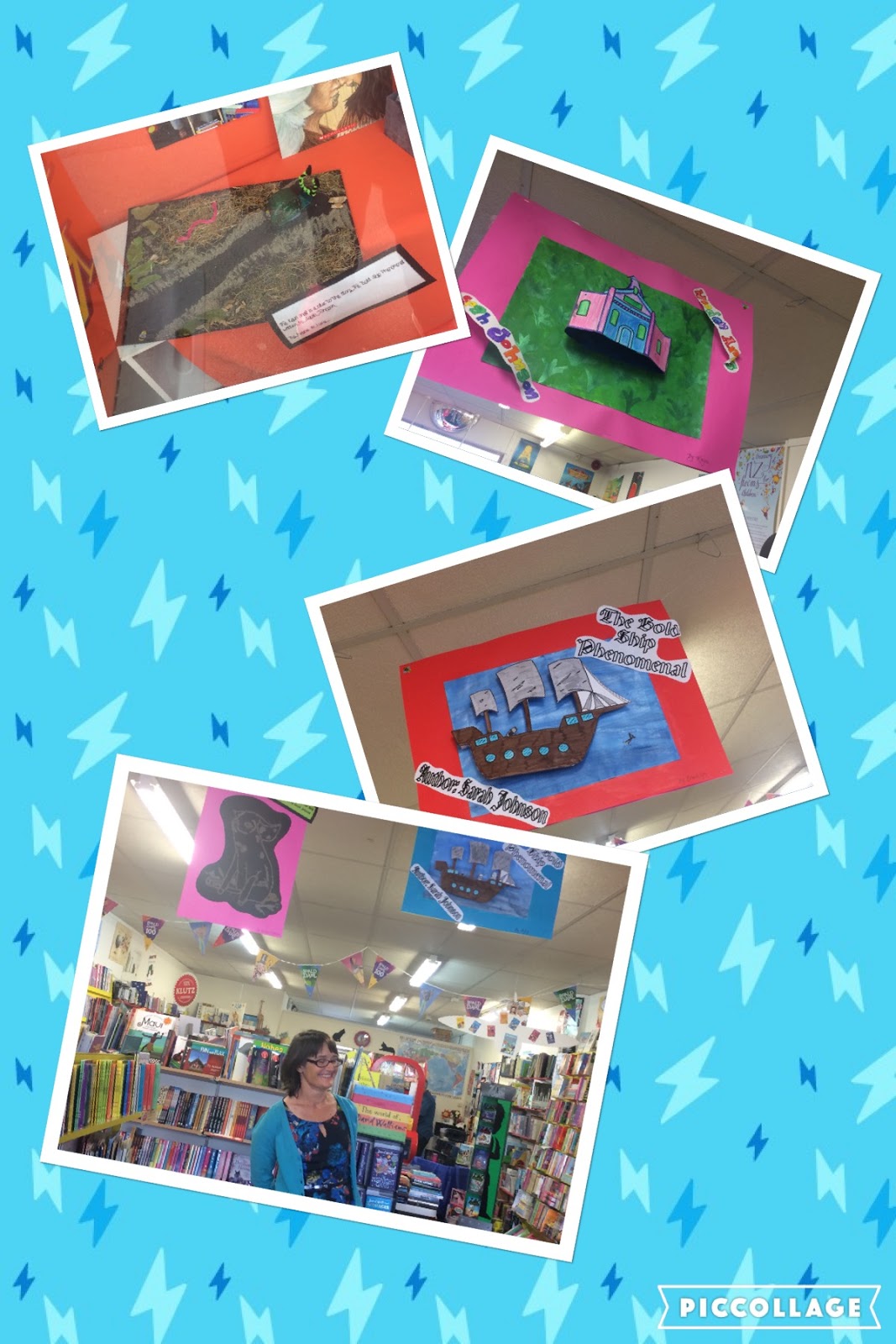
Then on Saturday, I was at Books For Kids in Hamilton East, helping Anne and Helen celebrate the bookshop's 45th birthday. Lots of the Bankwood kids came in, and they made this fabulous artwork to decorate the shop.


Sunday, I was at the Raglan creative market with Deb Hinde, selling books. Deb was selling her latest book, Hare (as well as several others), which has only been out for two weeks!


Then on Tuesday, Sherane from Koromatua School sent me these fabulous pictures of all the artwork her class has been doing since I visited last month. I love those ship-in-a-bottles! Sherane tells me they are easy to make, so I'll have go this weekend. I doubt mine will look anywhere near as good as the kids though.


Thank you Bankwood and Koromatua Schools. I have had such a fabulous time sharing writing with you this year.

Tuesday, 12 April 2016

Wooden Arms on stage

Ben built me my own whare manaaki tangata.
 

Here it is in action at the Waikato Show last weekend, where, along with Judi Billcliff and friends, I staged my first ever production of Wooden Arms.


It was so much fun, but thank goodness that Judi, who's a drama teacher and performance poet for kids, was there to help! Check out her Rainbow Poetry website and Rainbow Poetry Facebook page to see Judi in action.

One of the good things about being an author is that it pushes you outside your comfort zone. Being on a stage is definitely outside mine!

But now that I've got my whare, Judi's going to give me some drama tips, then I'll use the Wooden Arms performance at school visits.

Thursday, 22 October 2015

Wooden Arms houses


Everywhere I go, I see Wooden Arms houses. Homes and buildings that have been used, inhabited, perhaps cherished, and now have been left behind.
I love these places – the stain of story that they carry in the grain of their wooden walls, the hollow in the tread of their step, the sign that once heralded both destination and function, but now only signifies loss. Absence.  

I’m also becoming increasingly aware that they are passing. Ghosts of buildings, a feature of any road trip landscape, but fading, literally, before our eyes. Wood. Tin. The rain will disperse them all.
These ones I snapped at Mangaweka recently. If you had the inclination you could buy four shops for a bargain price. I wish I had cause to uproot my family to Mangaweka. Think of the stories you would inherent. The ghosts that would creep from the corners at night, each with their history to tell. Priceless! 


This one is in a valley near where I live. I like to think the shuttered windows mean someone means to return to it someday. Or maybe they're still inside - one window is slightly ajar!


Friday, 5 June 2015

It’s a first – twice

I’ve had two pleasant surprises and two firsts in one week.

First (of the firsts) is this online listing for The Bold Ship Phenomenal on Nationwide Book Distributors website.  They’re distributing the book for me, and they’re taking trade pre-orders now.

 
The second first is The Bold Ship Phenomenal’s first review. This is what Sue Copsey says about it on her blog.

“…The Bold Ship Phenomenal, due out later this year, made me cry as I edited it. It’s not a sad book though – the make-you-cry bit is just a small part. The rest is a page-turning adventure with a ship in a bottle as its star, and a strong nature theme. It’s classically New Zealand, but everyone, everywhere will love it. Take my word for it!”

 
Thanks Sue, although I hope there wasn’t too much crying going on (it’s not meant to be sad – well just a smidgen).

So what with two surprises and confirmation that printing is underway in China, it’s been a pretty exciting week all round. The Bold Ship Phenomenal, as a book, rather than a story, is beginning to feel real.

Friday, 15 May 2015

I need a new book-home, writing studio, bum


The really exciting thing about this photo is not my book (unfortunately), but where it’s taken.

The book (lucky thing) is now living in the writing studio of my wonderful writing colleague Dawn McMillan, where it is among very esteemed company (I hope it is behaving).


Dawn’s own (numerous) books are consistent best-sellers. In fact, I Need a New Bum (Libro International, 2012), rarely drops off the New Zealand bestseller list, and if it does, it soon bounces its way back up.


Why Do Dogs Sniff Bottoms (Penguin NZ, 2008) is also often there, and her recent picture book, Doctor Grundy’s Undies (Libro International, 2014) (about a pair of flash flying undies) is currently sitting on Whitcoulls Top 10 Books for Children list.


Notice in the picture, there's another of Dawn's books there too!


But Dawn doesn’t only write about bottom-related topics. Colour the Stars (Scholastic NZ, 2012) is about a boy describing to his blind friend what colours smell, feel, taste and sound like. What a fabulous idea! And just one of many when it comes to Dawn’s books      


But what I am really jealous of (going back to my book and the company it now keeps) is Dawn’s writing studio.

I suffer from shed-envy in general. I really, really love sheds, especially older rustic ones, and when I spot a promising shed, I love to imagine what I would do in it, if it were mine. There is something special about sheds – their self-containment, and sense of promise that they will, in turn, contain the user, freeing the person to create, build or dream, or any of the other things that people like to do in sheds.

But Dawn’s studio (which after all is just a posh shed) is truly one to be coveted. I have only seen it in this picture, but apparently, in addition to being gorgeous, it looks out over the beach.


To me it looks like writing heaven. No wonder Dawn’s books are so good. If you don’t yet know them, or do but want to find out more about Dawn’s shed and what happens there check out her website or blog.

They’re both as full of life as Dawn is, and she also runs a monthly competition to win one of her books.  Here she is with some of her fans from Te Puru school, doing what all good children's writers do best - reading a book.


Sunday, 19 April 2015

Conversations about self-publishing for the serially challenged 4: dotting your i’s


Looking at the title I chose for this series of blogs, I’m beginning to feel rather less serially challenged than when I began. I realise I’ve learnt a huge amount, along the way. That can only be a good thing if self-, or indie-, or hybrid-publishing is to become more the norm for New Zealand authors. I now have a much better idea of what is involved, and to be honest, it’s very exciting.
In past posts I have talked about it surprised me how creative the editing side of things is. Now as I move more into the actual publishing process what surprises me is how much fun it is. I’m having a blast. I guess that’s not surprising, given I love books (of course I’d enjoy making one of my own), but still it is not what I expected. Lots of work – yes – but very enjoyable too.

A friend who is herself considering self-publishing asked me recently what exactly I have been doing. I sent her the email below, in the hope it would help her process when she reached that stage. I hope it helps yours too.

What you'll need to do:
1.      Finish writing your book.

2.      Get it professionally edited – this step is kind-of optional, if you’re also an editor, but not really if you want a good product. It’s extremely hard to objectively edit your own work.

3.      Get it proofread ­– also only kind-of optional. The last thing you want is errors.

4.      Find and brief a book designer ­– there are plenty. Find one whose covers and internal designs you like, and who produces the type of books (in terms of format) that you’re after.

5.      Find and brief an illustrator – if you are using one. I have been lucky to have a friend whose work I know is wonderful. She’s doing my cover and internal illustrations. Otherwise, you may need to find a cover image you want to use (unless your designer does this for you).

6.      Decide on a publishing name and logo (if you are using one). Also, whether or not you are going to form a company. My accountant has advised the latter may be a good idea if I plan to publish more books, especially by other authors. Something to think about for the future.  

7.      Get an ISBN number, or several if you’re printing in different formats; from the National Library website. A very straightforward process, but you may need to query them if they tell you (as they did me) that you can’t have it until four weeks before the book is printed. Obviously this doesn’t work if you are printing overseas.

8.      Get a barcode – you can do this online. It’s based on your ISBN and costs around $30. I used Barcodes Limited (www.barcodes.co.nz).   

9.      Get quotes from a printer – I got a few, but you could get lots of quotes. There’s a big difference between them. I think I’m going to get the book printed in China, but actually some of the New Zealand quotes I got were getting close, in terms of costs.

10.   Organise a freight agent – if you’re printing overseas, this seems to be cheaper than letting the printers organise the freight, and there should be no hidden costs (fingers crossed). They should itemise all the subsidiary costs you’ll encounter when importing books.

11.   Find a distributor – there are several, but I have found them hard to raise a response from. I am unsure if this is because they are swamped with submissions from self-published authors or, conversely, are not yet used to dealing with them. You may have more luck if you have the designed product to show them. If you do get a response, they will send you their terms of trade, including how much commission they take and where they will try to place your book.

12.   Pay everyone, including the GST on the imported books. Kat says she got stung for this.

13.   Move onto the next big step: receiving, promoting and selling your book.

Whew! No wonder I’ve felt busy. But like I said, all good fun.  


Tuesday, 3 February 2015

The professional edit: Conversations about self-publishing for the serially challenged 3


I am two-thirds of the way through having the manuscript for my hopefully soon to be self-published book, The Bold Ship Phenomenal, edited, and what continues to amaze me is the extent of the changes that I, and now the editor, am making even at this late stage.


I work, in my day job, as a professional writer, so rewriting and rehashing and reimagining are no stranger to me. I actually enjoy them, and have no doubts that they strengthen a piece of writing.

It is the nature and size of these late changes that surprises. The Bold Ship Phenomenal has been through more structural and fine edits than I care to remember. It has been – rewritten, rehashed and reimagined. Yet I find I am revising whole scenes, adding new ones, strengthening connections, embellishing and excising details.

The process feels like tightening a belt, or a net, around the essence of the story, until its clarity is secured.   

I guess what I had not appreciated is how creative the external editing process would be, and in this respect, I feel I have struck it lucky with the editor I have chosen, Sue Copsey.

This no credit to me (all credit to Sue). Sue was a senior editor at Dorling Kindersley in London, before coming to New Zealand and freelancing for several publishing houses here. She is an established children’s writer in her own right.

There were no shortage of good options when I was looking for an external editor (one positive side of the current publishing crunch is that there are lots of talented publishing professionals now offering their skills on a freelance basis). But it was important to me that I found someone with experience working with children’s books. Children’s writing is different. It is magic and inspiration and wonder. Done well, it is transportation and transformation. An editor needs to get that. I feel confident that Sue does.

I’m also very grateful that she’s responded positively to my manuscript (thanks Sue). In the absence of a traditional publisher acting as gatekeeper, it can be hard to remain 100 per cent positive about the calibre of your work. Yet, paradoxically, it becomes even more important to maintain that calibre when you self-publish. This is your work, and there is only you to stand by it, so quality – of story, of process, of the finished product – becomes all.


I’ve found it helps to have supportive writer friends (‘Of course you must do it’), and I’ve also found encouragement to go ahead from an unlooked-for quarter – nature.
I love to walk (like lots of writer I find it a vital part of the creative process) and on recent walks I have increasingly stumbled upon signs from nature that support my decision to publish my story myself.

Now I don’t mean to sound like a fruitcake. I don’t mean that little birds have flown down and tweeted in my ear (or that whales have smiled at me or miniature pirates waved me on). What I have noticed is things in my environment, the west coast New Zealand environment, that have said to me – yes, this is what we are like, this is worth telling, this is wondrous and amazing, uniquely our own, there is a story in this: give it your best shot Sarah, it is worth writing about.

Tuesday, 23 December 2014

Wooden Arms goes international


Check out this picture of Wooden Arms being read to a class at the Anglo American International School in Moscow.


OK, so it helps that the reader (Nick) is the husband of one of my oldest friends. As a New Zealand children's writer, it's a good idea to have friends (or relatives) with kids in exotic places.  

I wondered what the audience would make of the New Zealand context, but apparently they loved it. I guess the theme of places we have loved and left is a universal one, especially for these international students, and in a city with such glorious buildings as Moscow.

There's a podcast of Wooden Arms being read by Matu Ngaropo on Radio New Zealand's website: you can listen to or download it here The recording is part of the Storytime Treasure Chest.

Friday, 29 August 2014

The structural edit: Conversations about self-publishing for the serially challenged 2

Phew! That was a mission.

I smile to see that, when I decided that the first thing I needed to do to get my manuscript – the Bold Ship Phenomenal – ready for publication was give it a structural edit, I allowed myself two weeks to complete the task.

How long has it taken me? Three months.

This is not the first structural edit mind you. In fact, it is probably closer to the twentieth. Yet when I decided to self-publish, it still seemed essential that I do yet another. The reason, I have realised, is the greater burden – to act as both creator and gatekeeper – that rests on the self-published author.

In a traditional publishing model, you (the author) create something and the publisher says ‘yeah’ or ‘nay’. They are the gatekeeper; the arbiter of quality, freshness, appeal, and of being ‘good enough’. As self-publisher you must fulfil this role yourself. It is your work after all and you must stand by it (hopefully with pride) once it takes its place in the world.

Yet, it is a curious concept this ‘good enough’. One of the pitfalls of the traditional model is that good enough can lead to a lack of ambition and sameness in what is being publishing. Conversely, one of the wonders of the new indie publishing scene is the freedom it affords authors to produce and make publically available new and strangely beautiful and unsettling works.

Yet as any good editor will tell you, it is difficult (some would say impossible) for a writer to gain sufficient distance from their work to see what needs to be done to bring it onto its finest form.
Hence the delay. Rather than being a straightforward matter of shifting bits around, my structural edit has been an angst process of asking ‘Is this right?’, ‘Could this be better?’, ‘Will this appeal to readers in the way I intend, or is the appeal limited to me?’. In short: ‘Is this good enough?’


I have been cheered in this process by Austin Kleon, whose small books (Steal Like an Artist and Show Your Work) I stumbled upon mid-way through. Austin takes a pragmatic and enabling approach to the creative process, urging people to trust in the value of their creativity and put its products out there. (You can listen to his manifesto on stealing like an artist here.)
 
Of particular value was his insight (in Show Your Work) that “you don’t have to be a genius”.  Everyone, he argues, has something to contribute, and it is OK to “be an amateur”.

“Amateurs are not afraid to make mistakes or look ridiculous in public. They’re in love, so they don’t hesitate to do work that others think of as silly or just plain stupid,” he says (Workman Publishing, New York, p.15).

So it is with The Bold Ship Phenomenal. I do love this story. It carries part of me in it. So I must act like an amateur and be willing to put it out there and potentially look ridiculous in public, while at the same time doing everything in my power to make it ‘good enough’. I owe it – I feel – to the story and to the readers who will (again hopefully) one day share it.  

Friday, 20 June 2014

An interview with the super-author and super-illustrator of Super Saffron, Victoria M. Azaro


One of the good bits about being a writer is all the talented creative book people that you get to meet. Writers, illustrator, book designers and producers: New Zealand has lots of them, even though we’re only small.
Victoria M. Azaro is one of these, and I consider her super-talented even by talented people’s standards. And the good news is she’s just produced a new book.
Super Saffron hit the shelves a couple of months ago and is a compilation of Victoria’s previous three Saffron books  Saffron (Mallinson Rendell, 2009), Saffron: I have everything under control (Mallinson Rendell, 2010), Saffron: So quite excellent (Penguin, 2012) – but with loads of added extras.

For those of you who don’t yet know Saffron, she’s phenomenal. She’s spunky, funny and ‘so quite excellent’ at getting herself, and little sisters Sage and Star Anise, into tricky situations (while Dad talks on his cell phone, and Mum practises yoga poses and dispenses calming essential oils).

Victoria is from Argentina, and worked as an international fashion designer and artist before she turned to writing and illustrating books, about 10 years ago. As a result, her stories are crammed full of overseas adventures, and gorgeous illustrations (with lots of fabulous frocks).

Victoria says, “I would like to think that my writing is FUN, and that it exposes children in New Zealand to a wide range of cultures and ways of thinking.”

I can vouch for the fact that her writing has fun, as all three of my older boys have loved the original Saffron books, and we have reread them many times as bedtime favourites. So we’re all super-pleased that Super Saffron is now out (complete with 22 extra pages of fun activities), and that Victoria is working on a series about Saffron’s little sister Sage, to be launched later this year.

Victoria kindly agreed to answer some questions about her writing; her answers are below. But if you’d like to find out more about her work, what Saffron’s been up to lately, or how to buy her books, go to: www.victoriamazaro.com and www.saffron-sage.com.

Victoria’s websites are as gorgeous as her books: one look and you’ll be hooked.   

So…

Me:  When did you start making books and why?
Victoria: I started writing and illustrating (both at the same time) 10 years ago when my first son was one. It took me by surprise because I found it exciting, fun and a break from the adult world. It wasn't until my second son was born, three years later, that I decided to quit my job as an Art Lecturer and concentrate my time in a serious career in the publishing world.     

Me: How would you describe your work?

Victoria: I would like to think that it is FUN and exposes children in New Zealand to a wide range of cultures and ways of thinking. My favourite part is character development and that includes searching for my character's voice and also drawing it, I love the drawing part!

Me: Tell us about Super Saffron: how did the book come about?

Victoria: Super Saffron is a compilation of the three books in the Saffron series, but it also has an extra 20 pages of new materials. After my many visits to schools and bookshops I wanted to add some non-fiction aspect to the stories and I was able to do this in Super Saffron. This includes maps, a Spanish glossary, book club notes, a cake recipe from Mexico and some general knowledge games that focus on food, dress and customs.

Me: What’s next on your project list?

Victoria: Sage – Saffron's little sister – will have her own book, which will be released in September or October this year. It’s aimed at 6 to 8 year olds.

Me: And where can we get your books? 

Victoria: Super Saffron was launched in April 2014 and is available in all bookshops and online stores. For more info about my books or me, please visit my sites: www.victoriamazaro.com or www.saffron-sage.com. I’ll also be the June Star Author for Christchurch Libraries, so I will be blogging every week there.

Thank you Victoria (and Saffron and Sage) – we think you’re super!

Friday, 13 June 2014

Thank you Puketaha for the cheese

A big thank you to all the wonderful kids at Puketaha School who made my author visit such fun this week. I really enjoyed our time together, talking about the ins and outs of writing and book production.

And a specially big thank you to the clever young man who said, "A story is like cheese: the longer you leave it the sharper the flavour".

Isn't that fabulous! A reminder that all work benefits from being given time to rest and mature.

Tuesday, 3 June 2014

Hip Hop down to the granny beat


Talented Judi Billcliff is launching her second book of 'fun poems for kids young and old' his coming Sunday 8 June at 1pm at St Columba's School in Frankton, Hamilton.

Judi's poems are a treat for poetry lovers everywhere. Fun, funky and off the wall: if you're lucky enough to see them performed by Judi (which I assume we will this weekend), they're pocket-sized drama treats.

Judi is a drama teacher by trade and was a runner up in the 2013 National Poetry Competition. Granny Goes to Hip Hop is her second book, and like Judi herself, promises to be full of high-energy entertainment.

I interviewed Judi recently as part of the Between the Lines exhibition (she was one of the exhibitors). You can read the full interview to find out more about her inspirations and work, or visit the Rainbow Poetry website (and Judi's blog) for more about the launch and what else she's up to. See you there.     

Friday, 30 May 2014

Conversations about self-publishing for the serially challenged

It was a good week last week. I sent off two stories to publishers (with fingers tied in double-bows, sheep’s shanks and half-hitches) and am now in that lovely hiatus that opens up between sending a manuscript, and finding out it is not wanted.

When I started writing this was a period of breathless hope and anticipation for the post.  Now (having received my fair share of rejections), it is more a time of quiet pleasure: at having finished a project (an achievement in itself), and for celebrating the beginning of a story’s journey into the world, which is in fact what the initial submission is.

It’s also a time of excitement, because I get to start something new. While I always have a stew of ideas and story scraps milling around my writing desk, I find I have to focus on one story at a time if I am to get them out the door (and who wants a finished story hanging around? It’s like being hounded by a dog that wants a walk). So when one’s gone, I get to start the next. Wonderful!

Next up for me is The Bold Ship Phenomenal, a story that has been making circuitous journeys off my desk and onto the desks of publishers and back again for some years now, yet refuses to either find a home or lie down and die. It was shortlisted for the Kobo/NZ Society of Authors e-publishing prize last year, but didn’t win, so back, once again, it came.

Now I have decided to self-publish it (it is winking encouragingly up at me as I write). Being rather late off (or on) the bandwagon for most things, I have never self-published anything before, and other than a vague idea, am not even particularly sure how to do it.

So for the next few months, I’m going to record this particular journey in my blog, in the hope that what I find out may help, or at least amuse, some of you. It’s self-publishing for the serially challenged because it’s for people like me whose natural environment to date has been paper, who have large families (or even small ones) to care for, who work, who love to get out into the world and wonder and play (and frequently do), and who on top of that write…and now publish.

Looking at that list, all I can say is thank goodness for publishers who sometimes say yes. But thank goodness also for having options. I can’t wait to get started. I’ll let you know how I get on.  

And the picture? It's gorgeous Ngarunui beach in Whaingaroa Raglan where I live, but it's also where my little ship begins its journey. Not this beach, in particular, but any beach where the waves roll onto the sand, then retreat like beckoning fingers, leaving  behind treasures for sharp-eyed beachcombers to find...                

Wednesday, 12 March 2014

Take a peek Between the Lines


Something very exciting is happening in Hamilton during April. Garden Place Library is hosting the Between the Lines Exhibition, providing local children and book lovers with a rare opportunity to get inside the heads of some of the Waikato’s best known children’s authors and illustrators.
Between the Lines runs from 1 to 30 April 2014 and will reveal the inspiration and creative process behind a range of contemporary children’s books.
Wharepapa South illustrator and designer Deborah Hinde is coordinating the exhibition, which is supported by the Waikato Children’s Literature Association. Displays on 19 writers and illustrators from across the Waikato will focus on the inspiration, research and process that lies behind one of each of their books.

Deborah says, “We wanted to show that there is as much book-related talent and creativity here in the Waikato as in some of the larger urban areas. The exhibition is also a celebration of all the wonderful books for children that are being generated here.”

I am taking part in the exhibition (with my picture book Wooden Arms, illustrated by Scott Tulloch), as is fellow Raglan writer Andre Ngapo and Raglan illustrator Margery Fern. Other featured writers and illustrators include Deborah, Dawn McMillan, Alison Robertson, Des Hunt, Sharon Holt, Ann Neville, Claire Ashmore, Doug Wilson, Judi Billcliff, Kat Merewether, Michael Oehley, Paul Martin, Scott Pearson, Talia Evered, Tamsyn Rose, Fiona Williams and Yvonne Milroy. Together they represent writers and illustrators from across the children’s literature genres and age groups.

The exhibition’s official opening is at 5:30pm on Tuesday 1 April 2014 in the exhibition space on Level 2 of Garden Place Library, Hamilton. Everyone is welcome so please come along and bring your friends and whanau.


Tuesday, 11 February 2014

A fun night for children's book lovers

The Waikato Children’s Literature Association’s AGM is on this Thursday 13 February.

If you live in the Waikato and you don’t already know about this great organisation, it’s worth checking out their web page, then joining. Its purpose is to “work in the community to generate a love of literature and reading amongst children”. What could be better than that?

The association organises regular seminars and other opportunities to meet children’s writers and illustrators, and hosts the annual Waikato Kids’ Lit Quiz and an annual NZ Post Children’s Book Award review night.

I am giving a talk at the AGM about my work, alongside the talented Yvonne Milroy (Jimothy) and Tamara James (The World is Your Oyster). It should be a fun night, and I am looking forward to hearing more about their work. See you there.

Monday, 30 December 2013

I didn’t win, but…

I found out just before Christmas that my manuscript, The Bold Ship Phenomenal, didn’t win the Kobo Prize.

But…thank you to all you lovely people who voted for me. I appreciate it. I was so pleased even to be shortlisted and am now feeling very excited about what I may do with the manuscript in 2014. 

Big congratulations to Fiona Sussman who did win with her novel Sentenced. I will have to buy an e-reader, so I can enjoy her book when it’s published.

I’m feeling very excited in general about 2014. There are lots of wonderful creative projects on the horizon, including a new children’s novel (I finished the first draft a couple of weeks ago), a novel for adults that I’ve been working for years (about bonsai; they’re little trees), which I have also finally finished the first draft of, and an exciting collaboration with my friend, award-winning illustrator Deborah Hinde (this is her current best-seller, 10 Kooky Kiwis , isn't that cover gorgeous!). I can’t wait to get started.

Here’s wishing you a creative and story-filled 2014.

Sarah      

Tuesday, 19 November 2013

Podcast for Wooden Arms


I’ve just come across the podcast for Wooden Arms on Radio New Zealand’s website. It’s read (fabulously) by Matu Ngaropo, as part of their Storytime Treasure Chest. You can listen to or download it here.
Enjoy.

Wednesday, 13 November 2013

The next step


Voting has closed for the Kobo Prize, so thank you to everyone who voted for me (and to those who didn’t, but were nice enough to read my excerpt). I’ll let you know how I get on.

Regardless of the result, I have decided I want The Bold Ship Phenomenal to see the light of day, and that if Kobo don’t do it, I will do it myself. Part of the reason is that I studied publishing at university, and have always wanted to have go at creating a beautiful book for myself. The other part is that I am very fond of the story, and would like to release it into the world. Either way, the book, or books, need to be as good and as gorgeous as they can be.

There’s a lot to think about and learn, and I’ll keep you posted as I go, in case you decide to do the same yourself (or, like me, just find it interesting).

Fortuitously, I attended an excellent workshop at the weekend with The Storybridge crew (Jocelyn Watkin and James George) on self-publishing and marketing your books online. Their tag line is “We help you to tell your own story in your own way. The Story Bridge team offers a supported pathway to new heights for storytelling and publishing”. It’s very apt and I thoroughly recommend their courses (there are more) for anyone keen to hone their skills or get support for their writing practice.

Certainly I came away from the self-publishing weekend all fired up with ideas and expectations, and armed with great tips for how to create a quality book.

Wish me luck!

Tuesday, 15 October 2013

Voting has started for the Kobo Prize


Voting has started for the Kobo NZ Authors E-Publishing Prize. My children’s novel, The Bold Ship Phenomenal, is one of the five novels shortlisted for the fiction category. Very exciting!

So please go online and vote for me. Here is the link: Kobo prize voting.

40 per cent of the judging is by reader voting, so your vote will make a difference. (Blimey, I sound like a politician.)

For anyone who wants a little taster, I've included the first chapter below. You can read a longer extract on the voting site.

Many thanks and I’ll keep you posted how I get on. 
The Bold Ship Phenomenal
Chapter one

The problem with life, thought Malachi as he trudged along the tide line, was science. It wasn’t the only problem, no way, but at this point it was certainly one of his biggest.
“Science sucks,” he said, booting at the sand, so that it rose and scattered before him in a damp fan.  “Science sucks.” Then again, louder and louder, until he was practically shouting it, “Science sucks, science sucks”. And to make matters worse, science was the first lesson of the day and he was already late. “Scien...”, he began again.
But then he saw the bottle and he stopped.
The bottle was propped, several meters below the tide mark, in a shallow pool left by the retreating sea. Further down the beach, the sea ssshh ssshhed as it slid onto the sand, but the pool that the bottle rested in was perfectly still, its blue-green surface cradling its glassy catch.
Normally this was exactly the sort of thing that interested Malachi. Stumbled upon treasures, jetsam and flotsam, he would scoop them up and squirrel them home to examine in the peace of his room. But today he couldn’t be bothered. Not with the way he was feeling, not after the way his day had kicked off.
He aimed another angry swipe at the sand and hoisted his bag up his back. He would have to hurry. But something about the bottle drew back his eye. Something about the way it reclined, as if it was struggling to stand upright, its top reflecting sunlight in smatters and sparks, like a miniature lighthouse on the shores of an inland sea.
Malachi dropped his bag and balanced on the pool’s edge to ease the bottle free. The bottle was large and surprisingly heavy. Slime-stained string coiled around its neck, below an orange wax bung. Grey barnacles clung on its belly and base, and its glass was coated in algae and a thick clouding of salt. 
Malachi stretched his sleeve over his hand and dipped his palm in the pool. He rubbed the bottle with the wet sleeve, trying to make a clear space in the glass. As he rubbed, the sound of the ocean filled his head. Gently at first – shh, shh, shh – then building, until the waves’ song thumped and thundered on the shore.
Startled, Malachi looked up, but the beach was quiet. The waves along the tide line had shrunk if anything, melting back into themselves before they finished their journey up the sand. Only the occasional sea bird, flying low, moved or called.
Malachi looked back down at the bottle but his rubbing had made no difference and the glass was still too murky to see inside. The bottle was certainly heavy though, as if it may be full, although when he shook it no liquid sloshed against the glass. He would have liked to take it home and clean it properly, see what was inside, but he was too late for that. Being late was Dad’s fault, but if he was any later Mrs Green would be back on the phone, back on his case, and that was the last thing he needed. Cleaning the bottle would just have to wait.
He took off his jersey and wrapped it carefully around the bottle, before clearing a space in the top of his pack. He placed the bottle in, did up the zip and eased the pack onto his back. Then, trying to keep as even a gait as possible, he jogged along the tide line, making up for lost time as he headed straight for school.