Showing posts with label school visits. Show all posts

Saturday, 15 April 2017

A week of thank yous


This week I’ve visited three schools who have been taking part in #NZReadaloud and reading The Bold Ship Phenomenal: Selwyn Ridge in Welcome Bay in Tauranga, Knighton in Hamilton, and Marist in Mt Albert in Auckland.

Look at all these amazing thank you cards that the students kindly made for me. 

The jar in the middle is full of messages-in-a-jar (rather than a bottle). So cool!


It’s me who needs to be thanking the teachers for inviting me, and the kids for being so interesting and interested. I really enjoyed hearing their ideas about the story; in particular, where the ship had gone and what was sunk beneath the buoy. Some of them even offered to write the next book for me!

Here’s some close-ups of a few of the wonderful cards.


One of my favourite thank you messages was from Theo who said: “I enjoyed how the story was kind of dull then BAM! At chapter 28, PLOT TWIST.”


Chapter 28! That’s two-thirds of the way through the book! I’m so sorry Theo that you had to wait so long for it to get exciting. I promise in my next book I’ll put a plot twist much nearer to the start. 


Friday, 25 November 2016

Thank you Koromatua and Bankwood schools


This past week has been busy. On Wednesday, I attended Bankwood School's whole-of-school production of Wooden Arms. It was absolutely superb, with some very funny additions (like dancing gumboot-wearing farmers). You can see the video here.

I was really moved to hear my words being performed back to me: taking on a life of their own.

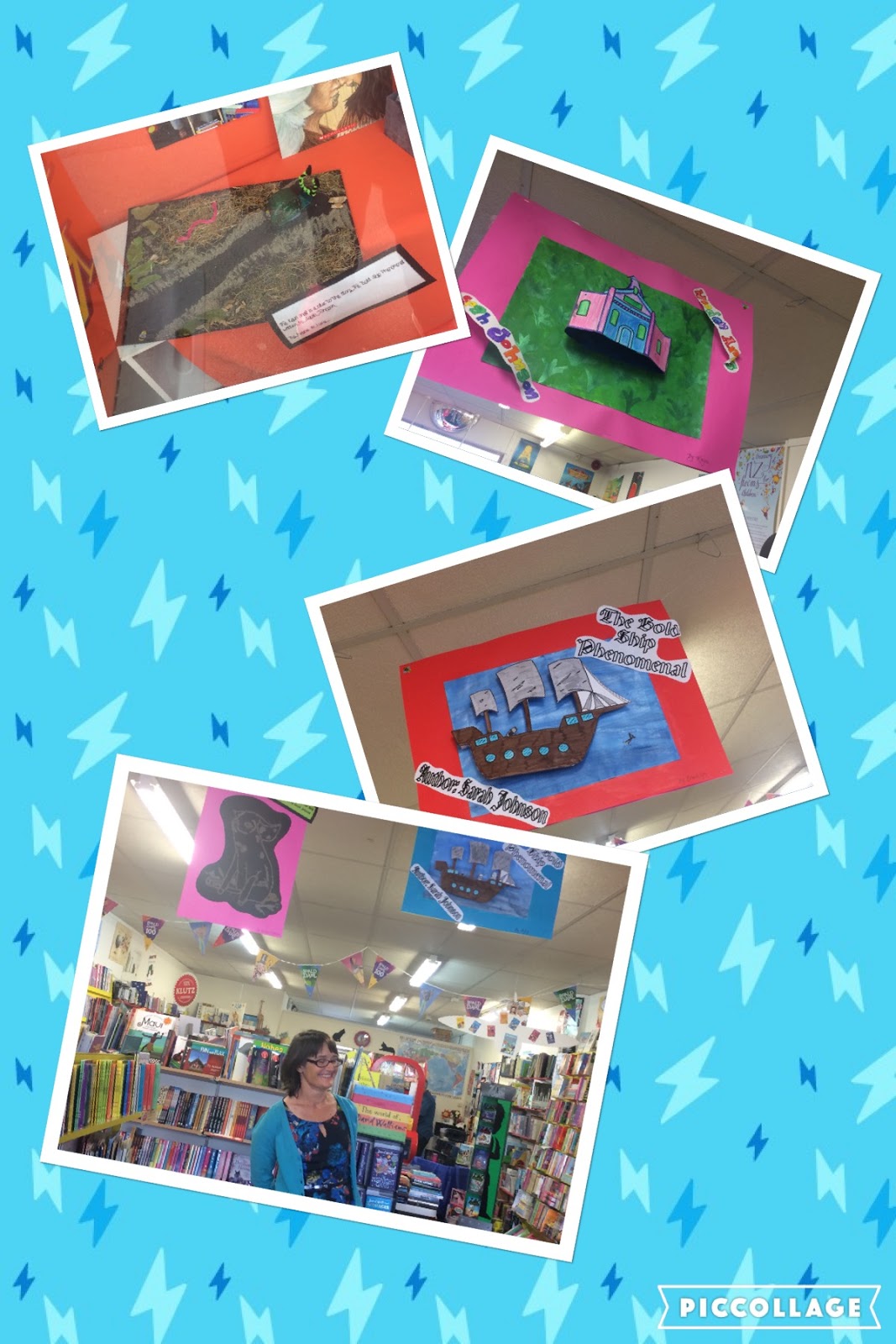
Then on Saturday, I was at Books For Kids in Hamilton East, helping Anne and Helen celebrate the bookshop's 45th birthday. Lots of the Bankwood kids came in, and they made this fabulous artwork to decorate the shop.


Sunday, I was at the Raglan creative market with Deb Hinde, selling books. Deb was selling her latest book, Hare (as well as several others), which has only been out for two weeks!


Then on Tuesday, Sherane from Koromatua School sent me these fabulous pictures of all the artwork her class has been doing since I visited last month. I love those ship-in-a-bottles! Sherane tells me they are easy to make, so I'll have go this weekend. I doubt mine will look anywhere near as good as the kids though.


Thank you Bankwood and Koromatua Schools. I have had such a fabulous time sharing writing with you this year.

Friday, 16 September 2016

Octopus in a rock pool


Recently, at the rock pools in Tairua, I had an amazing encounter. Octopi! Two of them, in the same rock pool.

That in itself is worthy of note: to find not one, but two beautiful octopi on the same day. But what happened next was even more amazing. One of the octopi, the larger one, raised its head to the surface of the rock pool and spoke…    


So here I am, an octopus in a rock pool.

It is not, to be fair, the most flash rock pool I’ve been in.

For a start, there are the shrimps: whiskery, flibberty creatures that pester an animal when he’s trying to hide. The anemones too, wink, stare.

Yet, in the absence of a larger claim to occupation, a seal say or an eel, I fancy I may call it my own.

What is that you say? You consider a rock pool not the safest place for an octopus to reside.

On the contrary! Note the abundance of nook and crevasse; perfect for containing a body soft as an over-ripe fruit. A fluid body, lithe and unencumbered by meddlesome bones.

You disagree? Claim a soft body can be disadvantage, in the presence of, say, a spear.

Oh, I see, you have one there.

Ah, yes, and here it is. You brandish it before you like a toasting fork over hot coals.  

Yes, yes, that is close enough; I assure you, I see your point.

Perhaps that is the downfall, after all, of a rock pool – no immediate means of escape.

Although containment can, itself, be offset by the proximity of the sea.

Yes, that’s right, the sea.

We are, after all, talking of a temporary inland outpost; the connection to the mother water remains.

You snigger, yet I would not expect you to understand, land lubber as you are, with your parcels and packages of tidily allotted ground. With the sea we take a broader view: connection rather than fence. Pool to sea to tributary, animal to animal, it is all as one.

Take, for example, my large friend here.

 Where? There. See there, where he rears behind you

Yes, indeed, he is an orca. Note the black and white warrior markings, the musculature of the sides.

Good idea, drop the spear, you’ll find it serves you little use now.

Now then, as I was saying…

So here I am, an octopus in a rock pool.       

Friday, 22 July 2016

Joy and books at school visits

It's the season for school visits and I've had several fabulous ones recently, with more scheduled for next month.

The wonderful photos below were taken during my visit to Te Mata School, when I was kidnapped by this cut-throat band of pirates. The whole school had dressed up for the occasion - what a treat!


One dedicated teacher (Tanya) at Bankwood School in Hamilton created this Glogster for her class to use in preparation for my visit. By the time I got there, the kids knew more about me and my books than I did. I really appreciated that effort.


Tanya says she's happy to share the Glogster for other teachers and librarians to use. You can download it here, and when I update my website (shortly) I'll include it on the school visits page as well.

Monday, 18 April 2016

There's a witches' cauldron on our beach


There’s a witches’ cauldron on Ngarunui Beach.

Have you seen it?

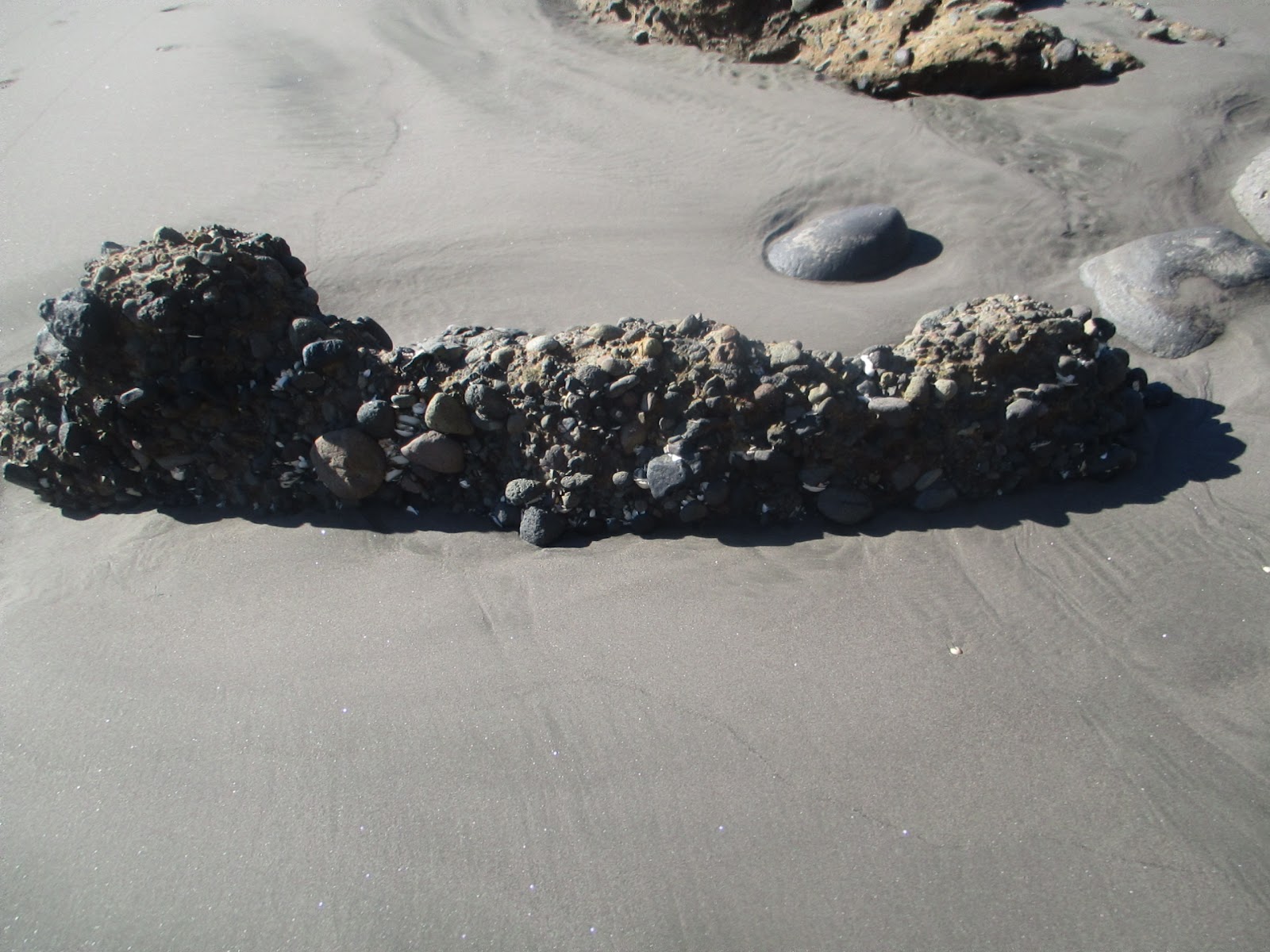
Three dinosaur eggs lie inside, smooth as stone.


Enormous nobbled creatures have populated the beach.

They wallow in their shingly sea.

Are they waiting? Will they rise?  


See the eye, the claw, the gristle spine, the grinding jaw.


The tide makes whales of the sandbanks

Grey backs breach and bask

Swimming for the hills.


Lone stone posts dot the shore

Like gnomes hats

They wig-wag in the breeze.


Footprints, imprints, tail slide, broom whisk

There’s a witches’ cauldron on Ngarunui Beach

Dare you see it?

Don’t fall in it!  

Tuesday, 12 April 2016

Wooden Arms on stage

Ben built me my own whare manaaki tangata.
 

Here it is in action at the Waikato Show last weekend, where, along with Judi Billcliff and friends, I staged my first ever production of Wooden Arms.


It was so much fun, but thank goodness that Judi, who's a drama teacher and performance poet for kids, was there to help! Check out her Rainbow Poetry website and Rainbow Poetry Facebook page to see Judi in action.

One of the good things about being an author is that it pushes you outside your comfort zone. Being on a stage is definitely outside mine!

But now that I've got my whare, Judi's going to give me some drama tips, then I'll use the Wooden Arms performance at school visits.

Sunday, 14 February 2016

Ms Blair recommends: The Bold Ship Phenomenal by Sarah Johnson

A nice review of my book by New Zealand book girl (Chrissi Blair) on her blog.


I've had a great time this morning trawling through the reviews on her site (I'm supposed to be working, but it's Valentine's Day). Lots of in-depth information there on kids' and young adults' books. My reading list has grown!

Here's the link... Thanks Ms Blair.

Ms Blair recommends: The Bold Ship Phenomenal by Sarah Johnson [Junior ...: The Bold Ship Phenomenal By Sarah Johnson Illustrations by Deborah Hinde Flat Bed Press, 2015 ISBN 9780473313142

Tuesday, 8 December 2015

Bold Ship Phenomenal listed as best Christmas buy

I'm chuffed that my book, The Bold Ship Phenomenal, was listed by The New Zealand Herald's Canvas magazine as one of the best books to buy for young readers this Christmas.


I'm doubly chuffed to be sandwiched between JK Rowling and the Thunderbirds. Hopefully some of their success will rub off. Bold Ships are go...

Enjoy a good scare? Author Sue Copsey tells us about her latest spooky story for kids...

I have just finished reading Sue Copsey's fabulous ghost story for kids - The Ghosts of Tarawera (Treehouse Books, 2015).

The Ghosts of Tarawera is book two in a planned series of New Zealand-based ghost stories for junior fiction and young adult readers (the first was The Ghost of Young Nick's Head (Pear Jam books, 2011)).

It's a wonderful, wonderful story, and a gripping read, which builds on and adds to the well-known ghostly appearances that preceded the Mount Tarawera eruption of 1886.

I've written a review of the book, which you can read on Goodreads (along with numerous four and five star reviews by other appreciative readers).

Sue kindly agreed to answer some questions about how she came to write the book, and what she has planned next - here's what she said. For more information, check out her website: www.suecopsey.com


Interview with Sue

The Ghosts of Tarawera draws on the famous New Zealand legend about the ghostly waka that appeared before the Mount Tarawera eruption. What was it that drew you to this story? 

I well remember the first time I read about this legend. I was editing a school textbook about the Taupo Volcanic Zone, and in amongst all this serious science there it was, as reported at the time (1886) by many tourists as well as local Maori. I was drawn to the story because there were so many witnesses:  two groups of Europeans in sightseeing boats, as well as villagers on the lake shore. The sightseers reported seeing an impressive war canoe – nothing spooky about it – but the Maori realised it was supernatural as there hadn’t been a waka of that type in the area in living memory. Local Maori also recognised it as an omen of disaster, and 11 days later were proved right when Mt Tarawera erupted. I reckon Lake Tarawera’s phantom waka, which legend says will reappear if the mountain reawakens, is far more credible than the Loch Ness monster, and look which is more famous. That’s just wrong!

Your story is very evocative of the landscapes around Lake Rotomahana and Rotorua. Did you spend much time there while you were writing the book?

I’ve been to this part of the North Island many times, so I had a good feel for it. I love the mix of forest, lakes, hills, Maori culture and weird and wonderful volcanic features. You can feel you’ve slipped back in time, to when dinosaurs roamed the Earth.

But also, Google Earth was my friend. While I was writing the book I had it almost permanently open as I zoomed in and out of satellite images looking for how the children would get across and around Lake Rotomahana before and during the eruption. When I’d finished, I hauled the family down to a bach near Mt Tarawera, and revisited the Buried Village, went on a boat trip on Lake Rotomahana, and kayaked on Lake Tarawera, making sure it all felt right, especially the atmosphere – I wanted the reader to feel they were really there, and recognise it if they visited.

What was the hardest part of the story to write, and why?

Writing the story was easy, it more or less wrote itself! But I was worried about getting the science right. I love popular science but wasn’t very good at it at school. Show me a physics equation and I feel a bit faint. I wanted to include lots of interesting facts about volcanoes and Mt Tarawera (I call it ‘education by stealth’), and to be absolutely sure I got it right, I asked GNS Science, who monitor NZ’s volcanoes and earthquakes, to check the manuscript for me. And so began the best correspondence I’ve ever had with an expert. Cornel de Ronde, who led the team that explored the lake floor at Rotomahana, contacted me, saying he loved how I was weaving all this geology into my adventure story, as he’s passionate about science education in schools. He was quite accepting of a few, ahem, liberties I took with the geology of the area in order to keep Joe, Eddie, Anastasia and Beckie alive. ‘They’d certainly die in an eruption such as you describe,’ he said. ‘But this is a moot point – it is a story, after all.’

What spooky tales did you enjoy as a child?

I liked the ‘true’ ones. Every village in Britain, where I grew up, had its spooks, and I had a book that listed just about every haunted house in the country. Thinking back, I must have been a weird child to have on holiday. Wherever we travelled in England, my twin loves of Enid Blyton’s Famous Five, and local folklore meant that I was always searching for secret passages and ghosts.

Have you ever seen a ghost?

Honestly, I don’t know – but something odd happened that makes me strongly suspect I have. It was my wedding night (seriously – no chortling please) and Michael and I were staying in a turret room in a Victorian hotel near my home town of Rugby. I was in bed and Michael was in the bathroom. In one wall was a small door which, without warning, flew open. A figure was silhouetted in the doorway, bright light behind. Then it slammed shut again. A bit like those sightseers with the phantom waka, I didn’t think this was anything supernatural, I just assumed someone had got lost in the hotel’s maze of corridors and ended up at our room by mistake. When Michael reappeared, I told him what had happened and asked him to move a table in front of the door. He did so, looking at me oddly – he thought I’d probably been half asleep (and yes, a few glasses of champagne had been imbibed).

Next morning we opened this little door to see a fire escape leading out onto the turret roof. So how could anyone have been out there, and why had there been a bright light behind them? Could this have been something spooky?

Feeling a bit silly, I asked the receptionist if the hotel had any ghostly residents, only to learn that there were several (most usually a coach and horses, a headless man, and a hand), and that people were constantly reporting strange occurences. Seems the hotel was, and still is, notorious for its ghosts – and we had no idea before that night.

This is your second novel about New Zealand ghosts. Is there another one on the horizon? And if so, can you give us a hint about the ghosts involved?

Yes indeed! Peeping over the horizon is The Ghosts of Moonlight Creek. I wanted to set my next ghost story in one of New Zealand’s old goldmining settlements, and discovered the wonderfully named Moonlight, near Queenstown. Anastasia’s movie director father is filming a fantasy movie down there and invites Joe, Eddie, Beckie and Anastasia to the movie set as a treat after their scare at Mt Tarawera. However, they soon discover filming is being held up by unexplained incidents, and the crew are beginning to call it a cursed film. I’m about a quarter of the way through and can’t wait to find out what happens!

Thursday, 22 October 2015

Wooden Arms houses


Everywhere I go, I see Wooden Arms houses. Homes and buildings that have been used, inhabited, perhaps cherished, and now have been left behind.
I love these places – the stain of story that they carry in the grain of their wooden walls, the hollow in the tread of their step, the sign that once heralded both destination and function, but now only signifies loss. Absence.  

I’m also becoming increasingly aware that they are passing. Ghosts of buildings, a feature of any road trip landscape, but fading, literally, before our eyes. Wood. Tin. The rain will disperse them all.
These ones I snapped at Mangaweka recently. If you had the inclination you could buy four shops for a bargain price. I wish I had cause to uproot my family to Mangaweka. Think of the stories you would inherent. The ghosts that would creep from the corners at night, each with their history to tell. Priceless! 


This one is in a valley near where I live. I like to think the shuttered windows mean someone means to return to it someday. Or maybe they're still inside - one window is slightly ajar!


Tuesday, 22 September 2015

Room 8 is GREAT!

Look at this wonderful blog post by the kids in Room 8 at Pukete School. Thanks guys, I had such a nice time...


Room 8 is GREAT!: Author Visit! As a part of our Inquiry into books, ...: Author Visit! As a part of our Inquiry into books, we had a visit from a New Zealand author Sarah Johnson. We read her story Wooden Arm...


Here's the picture collage they sent me afterwards. So cool!
 

Friday, 21 August 2015

A launch, a festival and a trio of reviews

What a week!
On Saturday I launched my latest children's book (twice) at the Word Café writers and readers festival: once for adults and once for children. Both events were wonderful.

Here's the cake that my lovely friend Zoe made for the celebrations.

 
And here's my equally lovely friend Dawn MacMillan entertaining the kids like the true professional she is.


And here's me looking very pleased with myself.
 
 
Since then my book has had three great reviews online.

"I really recommend this book because it had a lot of describing words that made me get a picture in my mind of what was happening. I like the adventure throughout the book, it made me really exited for what happened next. I would recommend it to people who have a liking for adventure."
  
Thanks Kaia. I'm so pleased that my very first review came all the way from Sweden. The Bold Ship has already travelled a long way!

Wednesday, 24 June 2015

Conversations in self-publishing for the serially challenged 5: crunching the numbers


The Bold Ship Phenomenal is safely out of my hands – in China being printed – so I thought I would look at the thorny question of costs.
When I decided to publish the story myself, one of my publishing ‘values’, as it were, was that the book had to be a top-class production. This was important to me, not only because I trained in publishing, but because this was my product: I had to stand by it for as long as it endured in the world, and I wanted to be proud of it.

I’ve done my best, and with the help of all the talented professionals who’ve played their part in getting the book to this stage, I think we’ve got a great result. But of course all this help costs, and what became clear very early on (in fact, before I even started, when I did my first rough budget) is that I was unlikely to ever make any money on it. Luckily that was never one of my aims.

I’ve listed the costs I’ve incurred below, so that anyone setting out on this route can see the type of expenses involved, and where they might be able to save on costs by finding a cheaper option or doing it themselves (something I haven’t been very good at).
The figures given are rough – both to protect my suppliers’ modesty, and to reflect the range of prices I was quoted for particular tasks (which on occasion, varied widely).

This list is not the end of the expenses, there is still warehousing, and promotion, and GST and other taxes, and bad debtors (assuming I make any sales) to contend with. But these are the bulk of the up-front costs, and I hope you’ll find them useful. Figures exclude GST.
·        Editing – $600

·        Proofreading – $250

·        Illustration – $1200

·        Design – $2000

·        Printing – $4000

·        Freight – $500 (very roughly, as this part of the process is still to come)         

→Total so far = $9400, which for 1500 books, means that $6.26 per book is production costs.
For a $20 book, where the bookseller takes 40% ($8), and the distributor 25% ($5), and the GST accounts for 15% ($3), you can see the quandary.

Except that it’s not a quandary, if you want to see your book in print. And looking purely at the dollar side of things overlooks the non-monetary gains, one of which has undoubtedly been the enormous help and support I have received from all the book professionals involved: worth every cent!     

Friday, 5 June 2015

It’s a first – twice

I’ve had two pleasant surprises and two firsts in one week.

First (of the firsts) is this online listing for The Bold Ship Phenomenal on Nationwide Book Distributors website.  They’re distributing the book for me, and they’re taking trade pre-orders now.

 
The second first is The Bold Ship Phenomenal’s first review. This is what Sue Copsey says about it on her blog.

“…The Bold Ship Phenomenal, due out later this year, made me cry as I edited it. It’s not a sad book though – the make-you-cry bit is just a small part. The rest is a page-turning adventure with a ship in a bottle as its star, and a strong nature theme. It’s classically New Zealand, but everyone, everywhere will love it. Take my word for it!”

 
Thanks Sue, although I hope there wasn’t too much crying going on (it’s not meant to be sad – well just a smidgen).

So what with two surprises and confirmation that printing is underway in China, it’s been a pretty exciting week all round. The Bold Ship Phenomenal, as a book, rather than a story, is beginning to feel real.

Sunday, 19 April 2015

Conversations about self-publishing for the serially challenged 4: dotting your i’s


Looking at the title I chose for this series of blogs, I’m beginning to feel rather less serially challenged than when I began. I realise I’ve learnt a huge amount, along the way. That can only be a good thing if self-, or indie-, or hybrid-publishing is to become more the norm for New Zealand authors. I now have a much better idea of what is involved, and to be honest, it’s very exciting.
In past posts I have talked about it surprised me how creative the editing side of things is. Now as I move more into the actual publishing process what surprises me is how much fun it is. I’m having a blast. I guess that’s not surprising, given I love books (of course I’d enjoy making one of my own), but still it is not what I expected. Lots of work – yes – but very enjoyable too.

A friend who is herself considering self-publishing asked me recently what exactly I have been doing. I sent her the email below, in the hope it would help her process when she reached that stage. I hope it helps yours too.

What you'll need to do:
1.      Finish writing your book.

2.      Get it professionally edited – this step is kind-of optional, if you’re also an editor, but not really if you want a good product. It’s extremely hard to objectively edit your own work.

3.      Get it proofread ­– also only kind-of optional. The last thing you want is errors.

4.      Find and brief a book designer ­– there are plenty. Find one whose covers and internal designs you like, and who produces the type of books (in terms of format) that you’re after.

5.      Find and brief an illustrator – if you are using one. I have been lucky to have a friend whose work I know is wonderful. She’s doing my cover and internal illustrations. Otherwise, you may need to find a cover image you want to use (unless your designer does this for you).

6.      Decide on a publishing name and logo (if you are using one). Also, whether or not you are going to form a company. My accountant has advised the latter may be a good idea if I plan to publish more books, especially by other authors. Something to think about for the future.  

7.      Get an ISBN number, or several if you’re printing in different formats; from the National Library website. A very straightforward process, but you may need to query them if they tell you (as they did me) that you can’t have it until four weeks before the book is printed. Obviously this doesn’t work if you are printing overseas.

8.      Get a barcode – you can do this online. It’s based on your ISBN and costs around $30. I used Barcodes Limited (www.barcodes.co.nz).   

9.      Get quotes from a printer – I got a few, but you could get lots of quotes. There’s a big difference between them. I think I’m going to get the book printed in China, but actually some of the New Zealand quotes I got were getting close, in terms of costs.

10.   Organise a freight agent – if you’re printing overseas, this seems to be cheaper than letting the printers organise the freight, and there should be no hidden costs (fingers crossed). They should itemise all the subsidiary costs you’ll encounter when importing books.

11.   Find a distributor – there are several, but I have found them hard to raise a response from. I am unsure if this is because they are swamped with submissions from self-published authors or, conversely, are not yet used to dealing with them. You may have more luck if you have the designed product to show them. If you do get a response, they will send you their terms of trade, including how much commission they take and where they will try to place your book.

12.   Pay everyone, including the GST on the imported books. Kat says she got stung for this.

13.   Move onto the next big step: receiving, promoting and selling your book.

Whew! No wonder I’ve felt busy. But like I said, all good fun.  


Tuesday, 3 February 2015

The professional edit: Conversations about self-publishing for the serially challenged 3


I am two-thirds of the way through having the manuscript for my hopefully soon to be self-published book, The Bold Ship Phenomenal, edited, and what continues to amaze me is the extent of the changes that I, and now the editor, am making even at this late stage.


I work, in my day job, as a professional writer, so rewriting and rehashing and reimagining are no stranger to me. I actually enjoy them, and have no doubts that they strengthen a piece of writing.

It is the nature and size of these late changes that surprises. The Bold Ship Phenomenal has been through more structural and fine edits than I care to remember. It has been – rewritten, rehashed and reimagined. Yet I find I am revising whole scenes, adding new ones, strengthening connections, embellishing and excising details.

The process feels like tightening a belt, or a net, around the essence of the story, until its clarity is secured.   

I guess what I had not appreciated is how creative the external editing process would be, and in this respect, I feel I have struck it lucky with the editor I have chosen, Sue Copsey.

This no credit to me (all credit to Sue). Sue was a senior editor at Dorling Kindersley in London, before coming to New Zealand and freelancing for several publishing houses here. She is an established children’s writer in her own right.

There were no shortage of good options when I was looking for an external editor (one positive side of the current publishing crunch is that there are lots of talented publishing professionals now offering their skills on a freelance basis). But it was important to me that I found someone with experience working with children’s books. Children’s writing is different. It is magic and inspiration and wonder. Done well, it is transportation and transformation. An editor needs to get that. I feel confident that Sue does.

I’m also very grateful that she’s responded positively to my manuscript (thanks Sue). In the absence of a traditional publisher acting as gatekeeper, it can be hard to remain 100 per cent positive about the calibre of your work. Yet, paradoxically, it becomes even more important to maintain that calibre when you self-publish. This is your work, and there is only you to stand by it, so quality – of story, of process, of the finished product – becomes all.


I’ve found it helps to have supportive writer friends (‘Of course you must do it’), and I’ve also found encouragement to go ahead from an unlooked-for quarter – nature.
I love to walk (like lots of writer I find it a vital part of the creative process) and on recent walks I have increasingly stumbled upon signs from nature that support my decision to publish my story myself.

Now I don’t mean to sound like a fruitcake. I don’t mean that little birds have flown down and tweeted in my ear (or that whales have smiled at me or miniature pirates waved me on). What I have noticed is things in my environment, the west coast New Zealand environment, that have said to me – yes, this is what we are like, this is worth telling, this is wondrous and amazing, uniquely our own, there is a story in this: give it your best shot Sarah, it is worth writing about.

Tuesday, 23 December 2014

Wooden Arms goes international


Check out this picture of Wooden Arms being read to a class at the Anglo American International School in Moscow.


OK, so it helps that the reader (Nick) is the husband of one of my oldest friends. As a New Zealand children's writer, it's a good idea to have friends (or relatives) with kids in exotic places.  

I wondered what the audience would make of the New Zealand context, but apparently they loved it. I guess the theme of places we have loved and left is a universal one, especially for these international students, and in a city with such glorious buildings as Moscow.

There's a podcast of Wooden Arms being read by Matu Ngaropo on Radio New Zealand's website: you can listen to or download it here The recording is part of the Storytime Treasure Chest.

Friday, 29 August 2014

The structural edit: Conversations about self-publishing for the serially challenged 2

Phew! That was a mission.

I smile to see that, when I decided that the first thing I needed to do to get my manuscript – the Bold Ship Phenomenal – ready for publication was give it a structural edit, I allowed myself two weeks to complete the task.

How long has it taken me? Three months.

This is not the first structural edit mind you. In fact, it is probably closer to the twentieth. Yet when I decided to self-publish, it still seemed essential that I do yet another. The reason, I have realised, is the greater burden – to act as both creator and gatekeeper – that rests on the self-published author.

In a traditional publishing model, you (the author) create something and the publisher says ‘yeah’ or ‘nay’. They are the gatekeeper; the arbiter of quality, freshness, appeal, and of being ‘good enough’. As self-publisher you must fulfil this role yourself. It is your work after all and you must stand by it (hopefully with pride) once it takes its place in the world.

Yet, it is a curious concept this ‘good enough’. One of the pitfalls of the traditional model is that good enough can lead to a lack of ambition and sameness in what is being publishing. Conversely, one of the wonders of the new indie publishing scene is the freedom it affords authors to produce and make publically available new and strangely beautiful and unsettling works.

Yet as any good editor will tell you, it is difficult (some would say impossible) for a writer to gain sufficient distance from their work to see what needs to be done to bring it onto its finest form.
Hence the delay. Rather than being a straightforward matter of shifting bits around, my structural edit has been an angst process of asking ‘Is this right?’, ‘Could this be better?’, ‘Will this appeal to readers in the way I intend, or is the appeal limited to me?’. In short: ‘Is this good enough?’


I have been cheered in this process by Austin Kleon, whose small books (Steal Like an Artist and Show Your Work) I stumbled upon mid-way through. Austin takes a pragmatic and enabling approach to the creative process, urging people to trust in the value of their creativity and put its products out there. (You can listen to his manifesto on stealing like an artist here.)
 
Of particular value was his insight (in Show Your Work) that “you don’t have to be a genius”.  Everyone, he argues, has something to contribute, and it is OK to “be an amateur”.

“Amateurs are not afraid to make mistakes or look ridiculous in public. They’re in love, so they don’t hesitate to do work that others think of as silly or just plain stupid,” he says (Workman Publishing, New York, p.15).

So it is with The Bold Ship Phenomenal. I do love this story. It carries part of me in it. So I must act like an amateur and be willing to put it out there and potentially look ridiculous in public, while at the same time doing everything in my power to make it ‘good enough’. I owe it – I feel – to the story and to the readers who will (again hopefully) one day share it.